The boarding school vs day school choice looks academic but is mostly about who runs the hours outside lessons. This comparison is for parents of 11- to 18-year-olds weighing a day school at home against boarding, often abroad. It compares models, not named schools, and gives no rankings or immigration advice.
We publish this at Schloss Krumbach International School (SKIS), a full-boarding school with no day places. Weigh our reasoning with that in mind.
Boarding School vs Day School: The Short Answer
The real difference in boarding school vs day school is where a child sleeps, which decides who runs evenings, nights and weekends. For lower-secondary students, lessons fill only about one hour in seven of a term-time week, by simple arithmetic from Education at a Glance 2025, published by the Organisation for Economic Co-operation and Development (OECD).
Martin and colleagues’ 2014 study of 5,276 Australian high-school students, one of the largest studies of boarding school to date, found “predominant parity” between boarders and day students. Where differences appeared after accounting for background, they were modest and tended to favour boarders. The boarding label alone does not decide how a child does.
On Independent Schools Council (ISC) Census 2026 figures, a UK senior boarding place costs about 1.65 times a day place at a boarding school, excluding VAT. The boarding premium pays for the hours outside lessons.
Day school tends to make more sense when a suitable school is within reach, family evenings work well and the child is not ready or willing to live away from home. Boarding becomes a stronger option when the right school is not available within a daily commute, when a structured residential week would solve a real family need, and when the child is ready and wants to board. Neither model is better by default.
- The real difference is who runs evenings, nights and weekends.
- Large studies find boarders and day students do about equally well.
- UK senior boarding costs about 1.65× a boarding-school day place (ISC 2026).
- Day school tends to make more sense when a suitable school is nearby and home evenings already work well.
- Families abroad have three options, not two.
Table of Contents:
- What Is the Difference Between a Boarding School and a Day School?
- Who Is in Charge Outside Lessons? The Responsibility Map
- Is Boarding School Better Than Day School? What the Research Found
- Boarding School vs Day School Pros and Cons, Side by Side
- What Does the Boarding Premium Pay For?
- When Day School Is the Better Answer
- Three Options, Not Two, for Families Living Abroad
- Should I Send My Child to Boarding School or Day School? A Decision Table
- Frequently Asked Questions
What Is the Difference Between a Boarding School and a Day School?
Each term below turns on where a student sleeps on a school night.
- Boarding school: A school in which students both study and live on campus during the academic term.
- Day school: A school whose pupils go home every evening.
- Day student: A student who attends a school that also has boarders but returns home at the end of the school day rather than living on campus.
- Full boarding: A residential educational model in which students live at school and follow a structured academic and boarding programme.
- Weekly boarding: A boarding arrangement in which students live at school from Monday to Friday and return home for weekends.
- Flexi boarding: Staying some nights and otherwise attending as a day pupil.
In the UK, the ISC Census 2026 counts 423 member schools with boarders. Only 10 are entirely boarding, and 77% have fewer than half their pupils boarding. At a mostly-day school, classmates go home after lessons, so a boarder spends evenings and weekends with a smaller group.
SKIS operates as a full-boarding school only. There are no day or weekly boarding places, so students share not only lessons but also the wider rhythm of supervised study, meals, activities, evenings and weekends. The boarding page explains how full boarding works at SKIS.
Weekly versus full boarding is a separate decision, made once boarding itself is settled.
Who Is in Charge Outside Lessons? The Responsibility Map
Across OECD countries, lower-secondary students average 922 hours of compulsory instruction a year, according to Education at a Glance 2025. Assuming a 38-week school year, that is about 24 hours of lessons in a 168-hour week (922 ÷ 38), roughly one hour in seven. Boarding school vs day school is mostly a choice about who runs the other six, block by block.
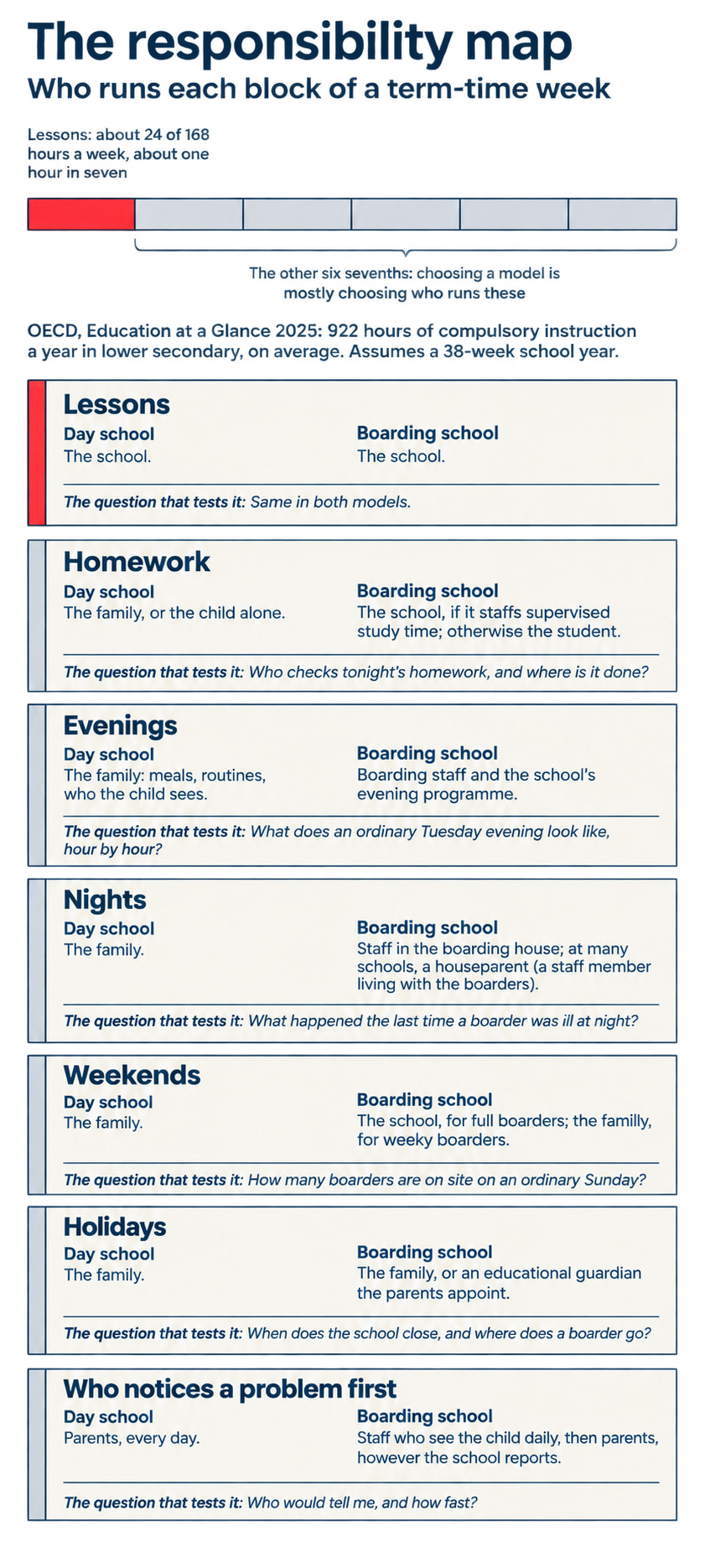
Responsibility map of a term-time week.
| Block | Day school | Boarding school | The question that tests it |
|---|---|---|---|
| Lessons | The school | The school | Same in both models |
| Homework | The family, or the child alone | The school, if it staffs supervised study time; otherwise the student | Who checks tonight’s homework, and where is it done? |
| Evenings | The family: meals, routines, who the child sees | Boarding staff and the school’s evening programme | What does an ordinary Tuesday evening look like, hour by hour? |
| Nights | The family | Staff in the boarding house; at many schools, a houseparent (a staff member living with the boarders) | What happened the last time a boarder was ill at night? |
| Weekends | The family | The school, for full boarders; the family, for weekly boarders | How many boarders are on site on an ordinary Sunday? |
| Holidays | The family | The family, or an educational guardian the parents appoint | When does the school close, and where does a boarder go? |
| Who notices a problem first | Parents, every day | Staff who see the child daily, then parents, however the school reports | Who would tell me, and how fast? |
Read the day-school column as a question about your own household. Every block marked “the family” needs an adult on hand, every school day, until your child leaves school. Who is home at 7pm on a February Thursday, three years from now?
The last row is the job of pastoral care: “The structured system through which a school looks after students’ emotional, social and physical wellbeing — through houseparents, tutors, counsellors and health staff.” Boarding schools fill the boarding column very differently.
One school’s answer, as an example rather than a norm: at SKIS, supervised homework is built into the daily and weekend routine, while teachers and boarding staff see students across lessons, study time, meals, activities and residential life. Weekends combine supervised academic preparation with reading, outdoor activity, sport and free time. During the major school breaks the boarding campus closes and students leave; Austrian national holidays are different and the campus remains open.
So at SKIS, too, the holiday row stays with the family. The school’s boarding policy sets out how supervision works at SKIS.
SKIS students presenting hand-drawn project posters to classmates in the school library
Is Boarding School Better Than Day School? What the Research Found
| Study | Students | What it found | Limits |
|---|---|---|---|
| Martin et al., 2014, American Educational Research Journal | 5,276 at 12 Australian high schools (28% boarders) | “Predominant parity” on most outcomes; some modest positive results favouring boarders; no notable difference in gains or declines over a school year | One country; gains tracked over one school year in a subsample of 2,002 |
| Martin et al., 2021, Frontiers in Psychology | 2,803 (481 boarders) at 6 Sydney independent schools | “Predominant parity” in motivation, engagement and achievement; the share of boarders in a class made no significant difference to class averages | 92% boys; one city; one point in time |
| Pfeiffer & Pinquart, 2014, School Psychology International | 706 adolescents at German boarding and day schools | Boarders showed higher levels of bullying than day students; more time with peers went with more relational victimisation (being excluded or talked about) | A pilot study; the authors suggest the higher open bullying could be explained by who attends boarding schools, since some students arrive after earlier social problems |
Boarding School vs Day School Pros and Cons, Side by Side
| Factor | Day school | Boarding school |
|---|---|---|
| Family time | Every evening and weekend at home | Family time is concentrated in holidays, calls and visits |
| Choice of school | Limited to schools within a realistic daily commute | Families can consider schools much further from home |
| Daily commute | Travel time every school day | No daily commute |
| Peer group | Classmates during the day; family and other friends after school | The same peers live and study together, so admissions and community culture matter more |
| Independence | Grows within the family’s routine | Can be practised daily through routines, self-management and increasing responsibility when the school deliberately builds these into boarding life |
| Responsibility and contribution | Primarily shaped through family life, school and activities | Can become part of daily residential life through routines, shared responsibilities, peer support and student leadership |
| Educational time | Learning is concentrated mainly in the school day; homework, activities and additional support are organised separately | A full boarding school can connect lessons, supervised study, activities, culture and residential life within one programme |
| Character and social development | Developed through family life, school, friendships and activities | Can also be practised daily through shared living, routines, independence, peer relationships, student responsibility and contribution to the community |
| The first weeks | No separation from home | Adjustment and homesickness may be part of the transition |
| Phones, screen time and sleep | The family sets the rules outside school | The school can set routines across the whole day; policies differ widely |
| Cost | Usually lower | Higher because the school also provides residential life outside lessons |
What Does the Boarding Premium Pay For?
In the ISC Census 2026, UK member schools charge senior boarders an average of £14,735 a term, against £8,928 for a senior day place at a boarding school. Both figures exclude VAT.
That makes boarding about 1.65 times a day place at a boarding school. The boarding premium is £5,807 a term; three terms make about £17,400 a year.
Day pupils at a boarding school attend the same lessons, so the premium pays for everything around them:
- a room in the boarding house
- meals beyond the school day
- adults on duty in the evenings, at night and at weekends
- the programme that fills those hours
A day family supplies those things itself: someone at home after school, transport, meals, sometimes tutors. Much of it never appears on a fee invoice.
Where the fee ends and the extras begin varies by school. At SKIS, the annual full-boarding fee includes academic tuition, classes of maximum 10 students, supervised homework and study support, accommodation, six meals and snacks each day, school technology and materials, regular sport, the main extracurricular programme and regular cultural and educational day trips. Medical insurance, uniform, airport transfers, overnight trips, holiday travel, official visa or residence fees and individually arranged activities are identified separately; families can ask the admissions team what the SKIS fee includes.
What Can Full Boarding Add to an Education?
Students collaborating in the school courtyard at Schloss Krumbach International School
The case for boarding is not only logistical. For some families, the attraction is the concentration of education that becomes possible when school does not end with the final lesson.
At SKIS, academic support continues beyond the classroom. Classes have a maximum of 10 students, so teachers can see who has understood, who needs another explanation and who is ready for greater challenge. Supervised homework, revision, regular feedback and structured study then continue that work after lessons. The student is not moving between school, a commute, private tutoring and homework at home. The academic day can be organised as one connected process.
Full boarding also makes it possible to fit more into a student’s week without turning every activity into another journey. Reading Club, sport, evening walks, ballroom dancing, theatre, music, cultural visits, museum trips and other activities can sit inside the same weekly rhythm as academic work and free time. Weekends at SKIS deliberately combine supervised preparation, reading, activity and genuine personal time.
That additional time is not intended simply to make students busier. It gives the school more opportunities to educate beyond subjects.
Students are gradually expected to manage their belongings, time, work and behaviour. Grade representatives support classmates. Older students help younger students and newcomers. Service teams contribute to meals, hygiene teams help maintain shared spaces, and students help organise events and traditions. Responsibility is practised repeatedly rather than discussed only in theory.
The same is true of social and cultural development. Students have to live with others, share spaces, resolve ordinary disagreements, communicate across ages and cultures, participate in formal occasions and contribute to a community. Traditions such as the Christmas Play, Historical Game and Summer Ball ask students to prepare, perform, cooperate, host, speak, dance and create something together.
For some parents, this is the real educational value of boarding. They are not paying only for a bedroom and supervision after class. They are choosing an environment that can invest more time in academic development, independence, cultural fluency, social skills, discipline and character.
At SKIS, care is close, but it is not intended to remove effort. Teachers support students without doing the work for them, and adults remain available while students gradually take more responsibility for themselves. The aim is a young person who can manage life more capably, contribute to a group and continue working when something is difficult.
For families who choose SKIS for this reason, boarding is therefore not a substitute for family upbringing. It is an additional environment in which the academic, social and cultural expectations of adolescence can be practised every day.

When Day School Is the Better Answer
For many families, day school is the right answer. The more of these five conditions hold, the stronger the case for day school:
- A school that fits your child is close enough to attend every day.
- An adult at home, whether a parent, grandparent or trusted carer, is consistently available for homework, meals, routines and the ordinary problems that arise after school.
- Your child is not ready, or not willing, to live away from home.
- You want to stay part of your child’s everyday routine, and that routine works.
- Paying the boarding premium every year until graduation would strain the family budget.
“Not yet” is a real answer too: day school now, with the question of when to board left open for a later year.
If the home routine is regularly difficult to sustain because of work, commuting, homework, screen use or conflicting schedules, that changes the comparison.
Three Options, Not Two, for Families Living Abroad
For a family living abroad, “day school” can mean two different things, and boarding is a third option.
The first is a day school where the family already lives: family evenings stay intact, but the choice is limited to local schools.
The second is relocation. One parent moves to another country with the child, who attends an international day school there; family evenings survive, at the cost of a split household or a paused career. Families should verify residence rules with an immigration adviser.
The third is boarding abroad, where the school runs the hours outside lessons and family time moves to holidays and calls. Among international students at UK member schools, boarding is the usual route: the ISC Census 2026 finds that 93.0% of non-UK pupils whose parents live overseas are boarders.
International families also need to compare what happens during school holidays and who holds responsibility for a minor in the school’s country. These arrangements vary by country and school. At SKIS, the School Principal acts as the appointed local guardian for international boarding students whose parents live abroad during their time in Austria. Major school breaks still require separate family travel planning because all students leave the boarding campus. SKIS is approximately 90 km from Vienna.
Should I Send My Child to Boarding School or Day School? A Decision Table
Six facts about your own household decide most of this choice.
| Your situation | Points to day school | Points to boarding |
|---|---|---|
| Schools within reach | A school that suits your child is within a daily commute | No school within reach offers the curriculum, language or peers your child needs |
| After-school hours | Someone at home can run homework, phone rules and bedtime | The family needs a more consistent structure for homework, meals, activities and evenings, and the school can provide it |
| Your child | Not ready to live away, or does not want to | Ready to live away, and wants to |
| Your role | You want a daily part in your child’s week | You are content to be a partner from a distance, kept informed by the school |
| Budget | The boarding premium would strain you every year | The full annual cost is affordable for every remaining year |
| Where the family lives | Settled, with no move planned | Abroad, moving, or far from a school that fits |
Boarding school vs day school comes down to who runs the hours outside lessons: the family or the school.
If most rows point to boarding, the next question is which school. One test belongs in any plan for how to choose a boarding school: put the questions in the right-hand column of the responsibility map to every school on your list. If most rows point to day school, there is no hurry to change.
Frequently Asked Questions
Boarding school is not better than day school on average. Martin et al. (2014), in the American Educational Research Journal, surveyed 5,276 students at 12 Australian high schools and found "predominant parity" between boarders and day students, with modest gaps, after accounting for background, leaning towards boarders. The studies compared models, not individual schools, so the boarding label alone is a weak guide. A better question is how a school runs the hours outside lessons, and whether it suits the child.
Choose day school when a suitable school is within a realistic daily commute, family routines outside school work well and the child is not ready or willing to live away from home. Consider boarding when the right educational environment is not available locally, when a structured residential week would meet a genuine need, and when the child is ready and wants to board.
The better question is not which model is superior. It is which environment fits this child and this family at this stage.
Average termly fees for UK senior pupils were £14,735 for boarders and £8,928 for day pupils at boarding schools, excluding VAT, in the Independent Schools Council (ISC) Census 2026. A boarder pays about 1.65 times as much, roughly £17,400 more over a three-term year. To compare a particular school, set its boarding fee beside its own day fee, both per year.
Compared with living at home, boarding means less daily family time, homesickness that is common in the first weeks, and higher fees. A peer group around the clock also cuts both ways, so who a school admits matters. One German pilot study of 706 adolescents (Pfeiffer and Pinquart, 2014) found higher levels of bullying among boarders than among day-school pupils.
Yes, a child can start at day school and move to boarding later. Many boarding schools also take day pupils, and some let them switch to boarding; elsewhere, a later move means changing school. A full-boarding-only school takes every student as a boarder from the first day.
Yes. SKIS is a full-boarding school for Grades 7 to 12. There are no day or weekly boarding places. Academic study, supervised homework, meals, sport, reading, extracurricular activities, student leadership, evening routines and weekends form one residential educational environment.
Because all students board, the peer community extends beyond the classroom. Students study, eat and live alongside one another, which is why SKIS considers motivation and personal fit as well as academic readiness during Admissions.
The aim is not simply to provide accommodation, but to create a structured environment in which students gradually develop academic independence, responsibility and the ability to live well with others.
Students are expected not only to receive support but also to contribute: to manage their own routines and belongings, support younger peers, take part in student leadership and shared responsibilities, and participate seriously in the cultural life of the school.
Teresa Schnabl is School Principal at Schloss Krumbach International School, a boarding school for Grades 7-12 in Krumbach, Austria. She contributes to academic and daily school leadership, communication with families and the organisation of school life.