Skip links

Student Visas and Residence in Austria: Parent Guide

Student visa for Austria for school children: the short answer

For families outside the European Union, the European Economic Area and Switzerland, a student visa for Austria for school children is the Residence Permit – Pupil (Aufenthaltsbewilligung – Schüler). The Residence Permit – Pupil applies to school stays in Austria of longer than six months.

According to oesterreich.gv.at, parents normally apply for the pupil permit at the Austrian embassy or consulate for their country of residence, before the child enters Austria. For a child under 18, the City of Vienna’s guidance requires a person with custody to lodge the pupil-permit application in person. The pupil-permit file must also prove that an adult living in Austria has been entrusted with the child’s care and upbringing.

Only some Austrian schools qualify for the pupil permit, such as public schools and private schools with public-law status, and the school supplies the enrolment confirmation. The pupil-permit fee is €218 for applications lodged from 1 January 2026, according to the City of Vienna’s guidance. The Austrian pupil permit is issued for up to 12 months and renewed in person in Austria, with the school’s written confirmation of academic success.

Schloss Krumbach International School has Austrian public rights, Öffentlichkeitsrecht, and therefore falls within the category of recognised private schools that can support an Aufenthaltsbewilligung – Schüler application, provided the student’s other legal requirements are met.

EU, EEA and Swiss children need no visa or residence permit for school in Austria, only a registration certificate for stays over three months.

Key takeaways

This guide is for parents outside the EU, EEA and Switzerland placing a secondary-school child in an Austrian boarding school, and leaves university permits aside. It summarises official Austrian guidance checked in October 2026: rules change, and families confirm their own cases with the Austrian embassy or consulate, the residence authority or an immigration adviser.

Table of Contents:

Which route applies: nationality and length of stay

Two facts decide what a child needs for school in Austria: the child’s citizenship, and whether the stay runs past 90 days or past six months.

Child’s nationalityUp to 90 days (e.g. a summer course)91 days to 6 months (e.g. one term)Longer than 6 months (a school year or more)
EU, EEA or Swiss citizenNo visaNo visa; stays over three months need a registration certificate (Anmeldebescheinigung)No visa or permit; request the registration certificate within four months of arrival
Third-country national, visa-free entryNo visa under Schengen rulesVisa DResidence Permit – Pupil
Third-country national, visa requiredVisa CVisa DResidence Permit – Pupil

Sources: Austria’s Agency for Education and Internationalisation (OeAD) and the Austrian Foreign Ministry (BMEIA) for the visas; oesterreich.gv.at for the registration certificate.

OeAD’s Visa C and Visa D guidance says a Visa C covers up to 90 days in any 180 across the Schengen Area. A Visa D covers 91 days to six months in Austria. OeAD advises applying no earlier than six months and no later than 15 calendar days before travel. Applicants also need travel health insurance of at least €30,000.

Whatever the route, anyone who takes up accommodation in a dwelling in Austria generally has to register the address within three days, under Austria’s Registration Act (Meldegesetz).

For a third-country national, a summer course or a trial term needs a visa at most. A school year or longer needs the pupil permit.

The residence permit for pupils in Austria, explained

The residence permit for pupils in Austria, officially the Residence Permit – Pupil, is a temporary residence permit for third-country nationals who attend school in Austria for longer than six months. The City of Vienna’s guidance sets a validity of at most 12 months. The permit is renewable by up to 12 months at a time while the conditions are still met. The pupil permit never outlasts the child’s passport.

The oesterreich.gv.at page on the pupil permit (in German) sets a minimum age: the child must have completed the sixth year of life. The child must also be a regular pupil of a public school, a private school with public-law status (Öffentlichkeitsrecht) or one of a few other listed types. Öffentlichkeitsrecht is the Austrian legal status granted to recognised private schools, allowing them to issue state-recognised reports and certificates.

The first question to put to any school is which permit category its enrolment confirmation supports.

Many English-language visa guides describe the university student permit, the Aufenthaltsbewilligung – Studierender (a separate permit with its own conditions). In OeAD’s words, that permit is issued to third-country nationals “admitted to study at a higher education institution in Austria”. A parent who follows those guides when looking for a student visa for Austria for school children is reading about the wrong permit.

Austria student visa for a minor: what changes under 18

The City of Vienna’s guidance states on its pupil-permit page (in German) that, for a child under 18, a person with custody must lodge the application in person. The same page adds that the child’s fingerprints are taken when the application is lodged. Who, living in Austria, will put their name to your child’s care and upbringing?

SKIS is located in Lower Austria, not Vienna. The City of Vienna guidance used here is a useful explanation of the national rules, but SKIS families should follow the instructions of the Austrian embassy or consulate and the residence authority responsible for the student’s address in Lower Austria.

Vienna’s guidance also requires written proof that the parents have entrusted the child’s care and upbringing (Pflege und Erziehung) to an adult. That adult must be 18 or over and live in Austria. The same page gives family members, a host family, school heads or educators at a boarding school as examples.

The examples are Vienna’s; the requirement is national, and oesterreich.gv.at lists the same proof for every applicant under 18. It adds that provincial rules may in some cases require a further foster-care permit; the residence authority can say whether that applies. Parents often call this adult a “guardian”; the application itself asks for an adult entrusted with care and upbringing.

For SKIS boarding students whose parents live abroad, the School Principal, Teresa Schnabl, acts as the school’s appointed local guardian during the student’s time in Austria. Families should coordinate the required declaration and supporting documents with Admissions before filing the application.

An Austrian student visa for a minor has a second threshold at age 14. From that age, the City of Vienna lists a criminal-record certificate from the home country among the extra documents for a first application. It must be no older than three months.

A minor's file: who supplies what

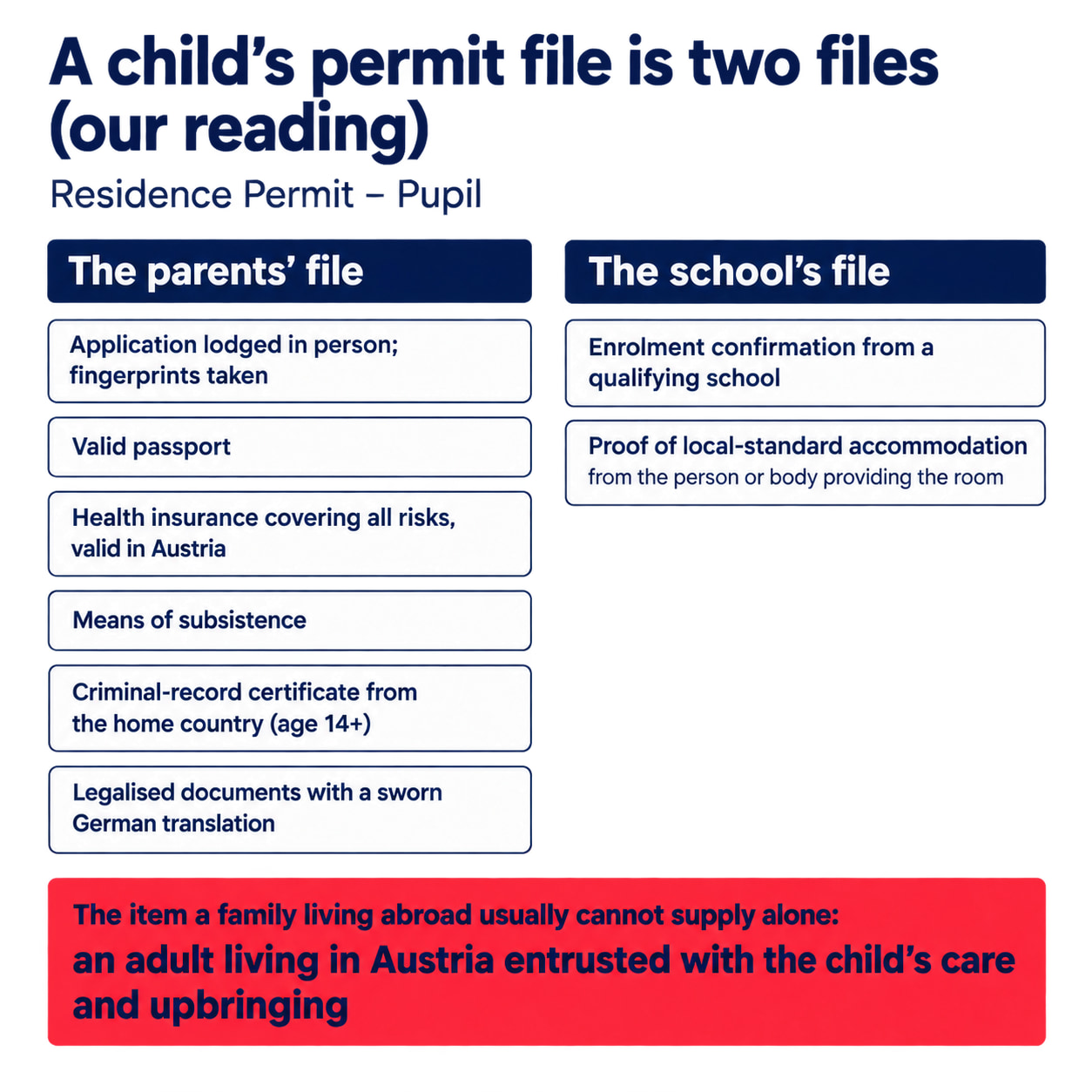
On our reading of the published requirements, a child’s permit file is two files, the parents’ and the school’s.

For families choosing a boarding school, the most school-dependent parts of the file are the enrolment confirmation, documentation connected with the student’s accommodation, and the adult in Austria entrusted with the minor’s care and upbringing. At SKIS, Admissions supports families with the school-related documentation, while the School Principal acts as the appointed local guardian for international boarding students whose parents live abroad.

The grouping in the middle column is ours; the sources set the requirement, not who supplies it.
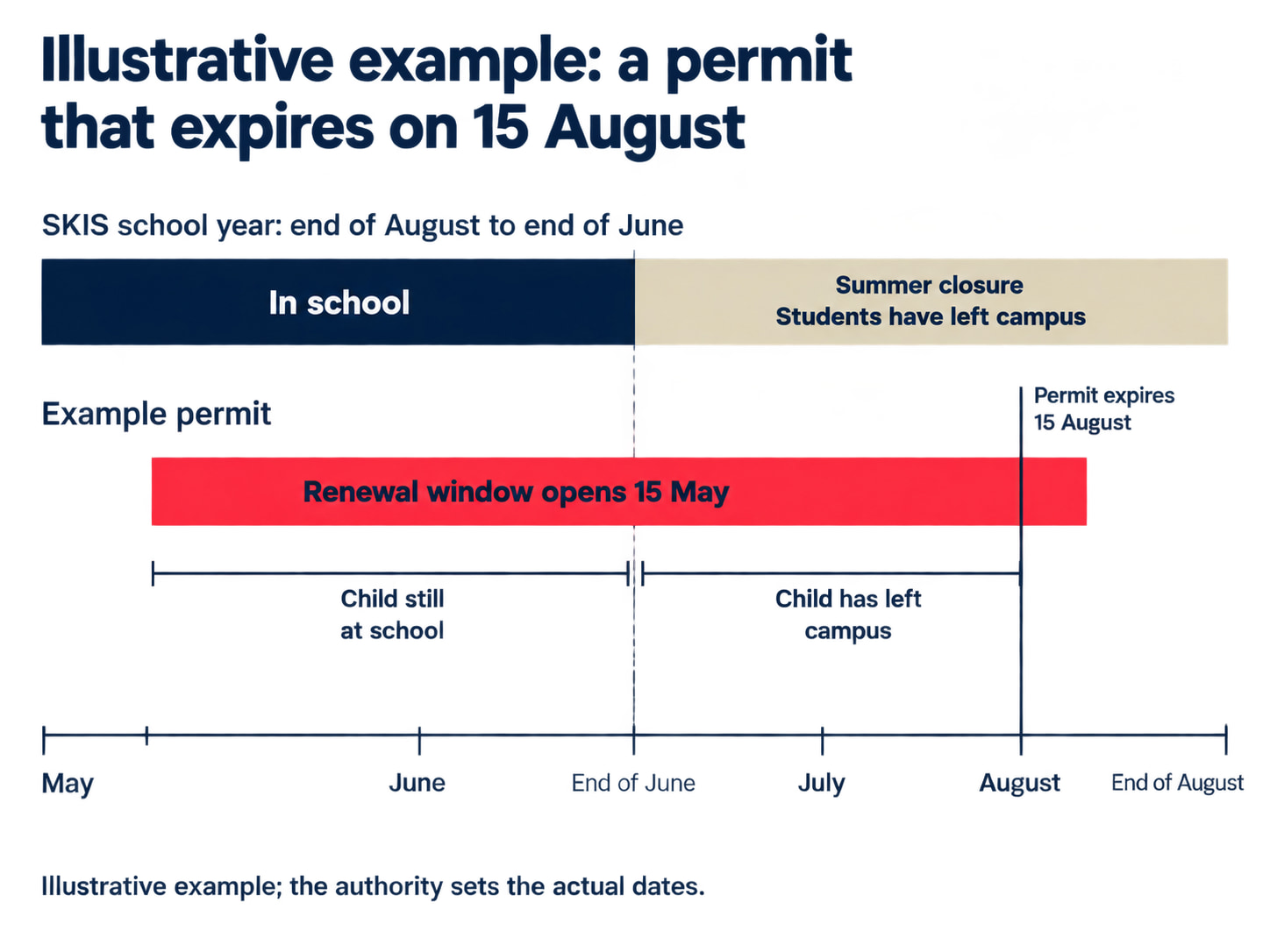
Diagram of a child’s Residence Permit – Pupil file as two files. The parents’ file covers six items, from the in-person application to legalised documents. The school’s file covers the enrolment confirmation and proof of accommodation. The item a family living abroad usually cannot supply alone: an adult living in Austria entrusted with the child’s care and upbringing The grouping is our synthesis of requirements published by oesterreich.gv.at, the City of Vienna and OeAD.

Main items in the fileWho supplies itOfficial source
Application lodged in person; fingerprints takenA parent or other person with custodyCity of Vienna
Valid passport (the permit never outlasts it)Parentsoesterreich.gv.at; City of Vienna
Enrolment confirmation from a qualifying schoolThe schooloesterreich.gv.at
Written proof: an adult living in Austria is entrusted with the child’s care and upbringingParents together with the appointed adult in Austria; for SKIS international boarders, coordinate this with Admissions and the School Principaloesterreich.gv.at; City of Vienna
Proof of local-standard accommodationThe person or body providing the roomoesterreich.gv.at; City of Vienna
Health insurance covering all risks, valid in AustriaParentsoesterreich.gv.at
Means of subsistence: €722.58 a month for applicants under 24 (2026 rate)ParentsCity of Vienna; OeAD
Criminal-record certificate from the home country (age 14+, ≤3 months old)ParentsCity of Vienna
Legalised documents with a sworn German translation (oesterreich.gv.at: English documents usually need no translation)ParentsOeAD; City of Vienna; oesterreich.gv.at

The City of Vienna’s 2026 reference rates for means of subsistence (in German) give €722.58 a month for pupils and students under 24. Means of subsistence is the monthly amount an applicant must be able to show for living costs. OeAD states the same figure for its student permit. Over a full year that makes €8,670.96, our arithmetic on the 2026 rate, not an official figure.

Legalisation means an apostille where the issuing country belongs to the Hague Apostille Convention, otherwise diplomatic legalisation.

Parents can prepare six of these nine items from home. The other three depend on Austria: the school’s enrolment confirmation, proof of accommodation from whoever provides the room, and the adult in Austria.

Step by step: what happens at home and what happens in Austria

Four of the seven steps can be done from home. The steps summarise oesterreich.gv.at, the City of Vienna’s guidance and OeAD.

  1. [At home] Secure the school place and obtain the school’s enrolment documents, including the confirmation required for the residence-permit application. For a SKIS international boarder under 18, also coordinate with Admissions the documentation required for School Principal Teresa Schnabl to act as the appointed local guardian.
  2. [At home] Assemble the parents’ part of the file: every item the table above assigns to the parents.
  3. [At home] Lodge the application in person at the Austrian embassy or consulate responsible for your country of residence, before the child enters Austria. A person with custody attends, fingerprints are taken, and the fee is €218 for applications lodged from 1 January 2026, per the City of Vienna’s guidance. Start as soon as the school’s documents are in hand.
  4. [In Austria] The residence authority responsible for the place where the child will live decides the Residence Permit – Pupil application. The Austrian embassy or consulate receives the first application abroad and forwards it to the competent authority in Austria. For a SKIS student living in Krumbach, this means the competent authority in Lower Austria, not Vienna’s MA35. Austria publishes no fixed decision period for an individual pupil-permit application, so families should not book travel on an assumed approval date.
  5. [At home] Once the permit is approved, the Austrian embassy or consulate issues a Visa D where one is needed, OeAD says — an entry visa, not the permit itself. The child uses it to travel to Austria and collect the card.
  6. [In Austria] Register the child’s address within three days of moving in (residence registration, Meldezettel), as the Registration Act requires. Who completes this for a boarder is a question for the school.
  7. [In Austria] Collect the residence card. For a child under 14, the City of Vienna’s guidance says the card goes to the person with custody or to the entrusted adult living in Austria.

OeAD describes one alternative for nationals who may enter Austria without a visa: applying at the residence authority in Austria instead of abroad. If no decision comes during the visa-free stay, they are responsible for leaving the Schengen Area.

Every year after: renewing the permit around the school calendar

Both oesterreich.gv.at and the City of Vienna’s guidance state that the pupil permit is extended in person, before it expires and no earlier than three months before. Because the permit is issued for up to 12 months at a time, the renewal comes round at least once a year. The same guidance requires the school’s written confirmation of academic success in the previous school year.

For a pupil under 18, the City of Vienna’s guidance says the renewal is lodged in person by the adult living in Austria entrusted with the child’s care and upbringing. The child’s fingerprints are taken again. A timely application lets the child stay in Austria while it is processed. Without one, OeAD notes, a person must generally leave the country once the permit expires.

For SKIS international boarding students under 18, families should coordinate renewal well in advance with Admissions and the School Principal, particularly if the renewal window overlaps with the summer period when students are away from campus.

OeAD’s FAQ for third-country students states that a valid Austrian residence permit allows travel within the Schengen Area for up to 90 days in any 180-day period. Where will the child be if the permit expires in the middle of August?

Boarding schools organise holidays differently, which changes whether the child is in Austria while the renewal window is open. Schloss Krumbach International School (SKIS) is a full boarding school in Krumbach, Lower Austria. Its school year runs from the end of August to the end of June. During school breaks, the school closes and all students leave campus.

On our reading of the published rules and the school calendar, a permit expiring on 15 August can be renewed from 15 May, while the child is still at school. Left until July, the filing falls in the weeks when the child has left campus, yet it needs the child’s fingerprints.

Check where the expiry date falls in the school year as soon as the card is issued. Then plan the filing with the adult who will lodge it and the residence authority.

Illustrative timeline using the Schloss Krumbach International School calendar. A permit expiring on 15 August can be renewed from 15 May, while the child is still at school. After the school year ends in June the school closes and students leave campus until the end of August. Illustrative example, our reading of the published rules and the school calendar; the authority sets the actual dates.


Parents and siblings: what the pupil permit does not give the family

The pupil permit allows no family reunification. The temporary-residence page on migration.gv.at lists the pupil permit among the permits whose holders cannot bring family members to Austria, and the City of Vienna’s guidance says the same. Under that rule, the child’s permit does not carry a right of residence for parents or siblings.

Parents who visit enter under the rules for their own nationality, and OeAD’s Visa C guidance applies to those who need a visa: up to 90 days in any 180.

On migration.gv.at, the pupil permit is listed under temporary residence, separately from the permits for permanent immigration and settlement. The City of Vienna’s guidance covers a pupil who wants to go on to study at university in Austria. That pupil must report the change as soon as possible and file a change-of-purpose application no later than the last day of the current permit. It is a new application, not an automatic switch.

Questions about long-term residence, settlement or citizenship for the child or the family belong with an immigration adviser; this guide does not answer them.

Before the embassy appointment: what to settle with the school

Most of the file for an Austrian student visa for school children can be prepared at home. What depends on Austria are the school’s documents, including any proof of accommodation it provides, and an adult living in Austria entrusted with the child’s care and upbringing. The conversation with the school belongs before the embassy appointment.

Our view is that the question of the adult in Austria comes first, because nothing else in the file can stand in for it — though how schools answer it differs.

Ask the schoolWhy it matters
Which school documents will you provide for our child’s Residence Permit – Pupil application?The application depends on documents from the school, including confirmation of enrolment. Families need to know exactly what SKIS provides and when it becomes available.
For a child under 18, what documents are required for the School Principal to act as the appointed local guardian?A minor’s application requires proof that an adult living in Austria has been entrusted with the child’s care and upbringing. Families should prepare this correctly before filing.
Which authority in Lower Austria will handle our child’s residence application after it is forwarded from the embassy?SKIS is in Krumbach, Lower Austria. The competent residence authority depends on where the child will live, so families should not assume that Vienna’s MA35 handles the case.
Who provides the documentation confirming our child’s boarding accommodation?Proof of suitable accommodation forms part of the residence-permit file. A boarding family needs to know which document the school provides for the student’s room on campus.
How does SKIS support annual permit renewals and provide evidence of school success?The Residence Permit – Pupil is normally issued for a limited period and must be renewed before it expires. Renewal requires school documentation, including evidence of academic progress or school success.
Which parts of the process remain the family’s responsibility?SKIS supports the school-related side of the process, but families remain responsible for personal documents, official applications, insurance, translations, apostilles or legalisation and government fees. Knowing the division of responsibility prevents missing documents or duplicated work.

Schools vary in the documents they issue and the level of support they provide. At SKIS, Admissions supports international families with the school-related part of Austrian visa and residence procedures. This includes providing required school documents and guiding families through documentation connected with enrolment. Once a student is enrolled, SKIS continues to handle relevant school documentation connected with the student’s school status. Official application fees, translations, legalisation, insurance and other personal immigration costs remain the family’s responsibility.

Applications to SKIS are accepted year-round. We encourage families to apply early, partly because of the visa and residence-permit procedure.

Take these six questions to the school before booking the embassy appointment; families considering SKIS can send them to the admissions team at info@krumbach.school.

Frequently Asked Questions

EU, EEA and Swiss children need no visa or residence permit for school in Austria. EU, EEA and Swiss citizens staying over three months request a registration certificate within four months of arrival. For third-country nationals staying up to six months, whether a Visa C or Visa D is required depends on the child's nationality and the length of stay. Longer school stays require the Residence Permit – Pupil.

Yes: Austria's Residence Permit – Pupil is open to children who have completed their sixth year of life and attend a qualifying school. Under the City of Vienna's guidance, a person with custody must lodge the application in person for an applicant under 18. An adult living in Austria must also be entrusted with the child's care and upbringing.

The fee for an Austrian pupil permit is €218 for applications lodged from 1 January 2026, according to the City of Vienna's guidance; oesterreich.gv.at lists the same fee.

The application fee is separate from other family expenses such as insurance, translations, apostilles or legalisation, and travel. At SKIS, normal school-related documentation and Admissions guidance for the residence procedure are part of the school's support for international families.

The following answers describe how these areas work at Schloss Krumbach International School.

Yes, within the Schengen Area: OeAD states that a valid Austrian residence permit allows travel for up to 90 days in any 180-day period. The date to watch is the pupil permit's expiry, because renewal is lodged in person in Austria before the permit runs out.

No: migration.gv.at and the City of Vienna both state that the pupil permit allows no family reunification, so parents and siblings cannot join the child under it. Questions about long-term residence for the child or the family belong with an immigration adviser.

Yes. SKIS supports international families with the school-related part of Austrian visa and residence procedures. Admissions provides the required school documents, explains which school documentation is needed and guides families through preparation from the school's side.

For boarding students under 18 whose parents live abroad, the School Principal, Teresa Schnabl, acts as the school's appointed local guardian in Austria.

Official residence decisions remain with the Austrian authorities, and families remain responsible for their personal documents, official applications, insurance, translations, legalisation or apostilles and government fees. Requirements vary by nationality and individual circumstances, so families with more complex cases should speak with Admissions early.

Interested in learning more?

Contact our Admissions Team or arrange a school visit to experience the SKIS community firsthand.

Explore
Drag
Schloss Krumbach International School
Privacy Overview

This website uses cookies so that we can provide you with the best user experience possible. Cookie information is stored in your browser and performs functions such as recognising you when you return to our website and helping our team to understand which sections of the website you find most interesting and useful.