Skip links

Relocation Checklist for International Families

This checklist is for parents moving their child to school abroad while the family stays at home, with a 12-18-year-old boarder in Austria as the example. It covers what to do, by when and who owns each step, without house-hunting or shipping.

Moving Your Child to School Abroad: The Short Answer

Moving your child to school abroad as a boarder relocates one person, not a household. Plan backwards from the first school day: the end of August at Schloss Krumbach International School (SKIS). Under the three-owner rule, each relocation step belongs to the family, the school or Austrian authorities.

Admission comes first, because Austria’s residence permit for pupils requires a confirmation of school enrolment. Pupils from outside the EU, EEA and Switzerland staying over six months generally file their first permit application from abroad, at an Austrian embassy or consulate.

EU, EEA and Swiss pupils need no visa or permit; they register their address within three days and obtain a registration certificate within four months of arrival. Confirm your own case with the Austrian embassy or consulate.

Key takeaways

The Backwards-Planned Relocation Checklist: What, When and Who

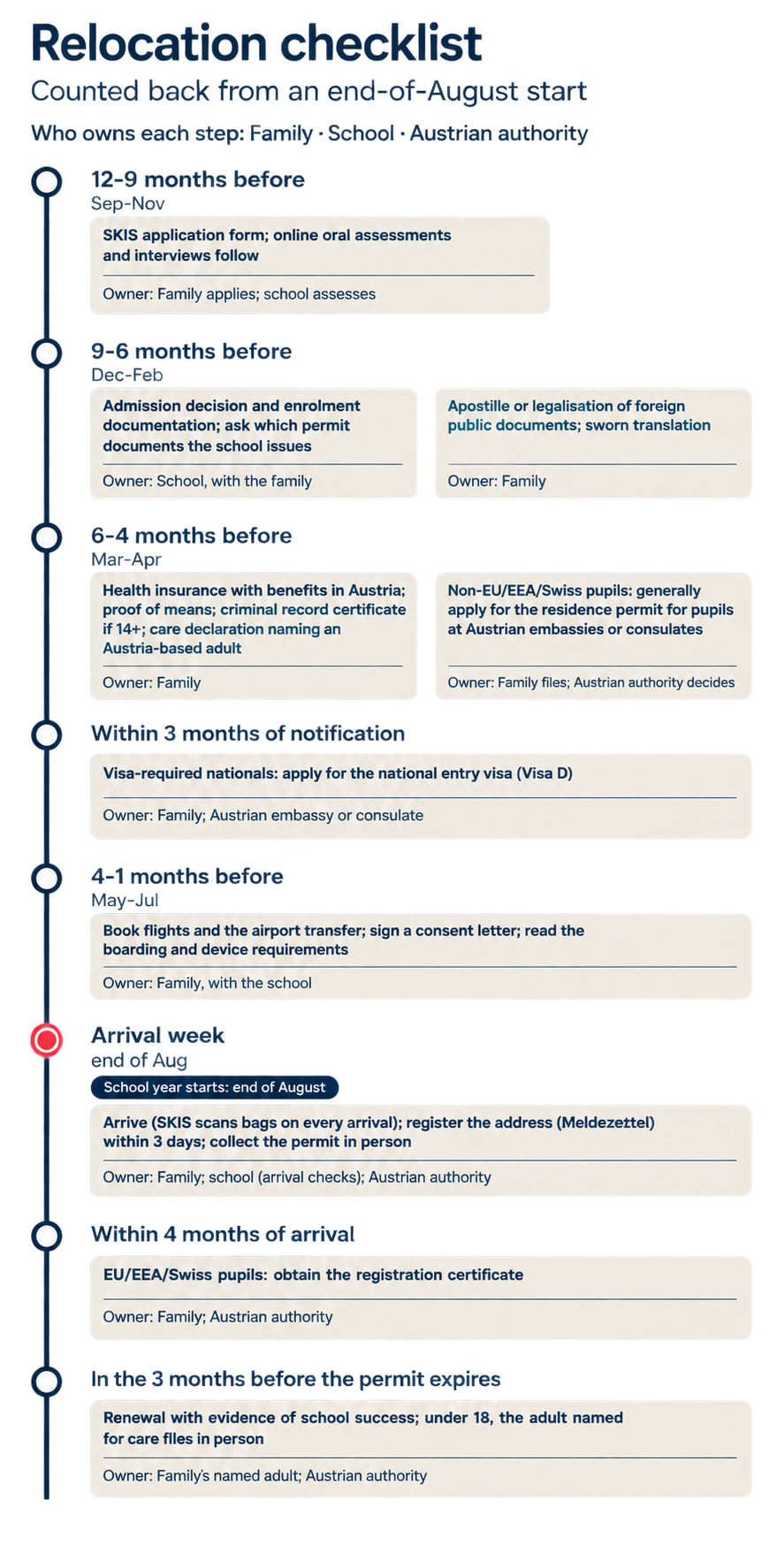
Each row names its owner under the three-owner rule. The windows are a general planning guide, not a SKIS rule, counted back from SKIS’s end-of-August start; legal deadlines come from Austrian authorities.

When (before an end-of-August start)StepWho owns it
12-9 months before (Sep-Nov)SKIS Application Form and €300 Application Fee. Applicants then complete online oral academic assessments in English, Mathematics, History and Geography, and Sciences; German is also assessed for Grades 7 to 9. A personal interview follows.Family applies; school assesses
9-6 months before (Dec-Feb)Admission decision, enrolment documentation and one-time entry fees (2026-2027); ask which permit documents the school issuesSchool, with the family
9-6 months before (Dec-Feb)Apostille or legalisation (authentication certificate) of foreign public documents; sworn translation of anything not in German or EnglishFamily
6-4 months before (Mar-Apr)Health insurance valid in Austria; proof of sufficient means; and, where required, a criminal record certificate for applicants aged 14 or over. Confirm the exact document list and validity period with the competent Austrian authority handling the application. For a minor, proof that an adult resident in Austria has been entrusted with the student’s care and upbringing. For SKIS boarding students whose parents live abroad, the School Principal, Teresa Schnabl, acts as the school’s appointed local guardian; Admissions can provide the relevant details for the family’s application.Family
6-4 months before (Mar-Apr)Non-EU/EEA/Swiss pupils: generally apply for the residence permit for pupils at Austrian embassies or consulatesFamily files; Austrian authority decides
Within 3 months of notificationVisa-required nationals: apply for the national entry visa (Visa D)Family; Austrian embassy or consulate
4-1 months before (May-Jul)Book flights and the airport transfer (charged extra at SKIS, 2026-2027); sign a consent letter; read the boarding and device requirementsFamily, with the school
Arrival week (end of Aug)Arrive (SKIS scans bags on every arrival); register the address (Meldezettel) within 3 days; collect the permit in personFamily; school (arrival checks); Austrian authority
Within 4 months of arrivalEU/EEA/Swiss pupils: obtain the registration certificateFamily; Austrian authority
In the 3 months before the permit expiresRenewal with evidence of school success; under 18, the adult named for care files in personFamily’s named adult; Austrian authority

Other schools divide the work differently; this international school relocation checklist shows SKIS’s split. Embassy processing times vary by country, so start the permit file as soon as the enrolment confirmation arrives.Timeline of the relocation checklist for a child boarding at Schloss Krumbach International School, counted back from an end-of-August start. Eight time windows run from 12 months before arrival to the permit renewal, and each step is owned by the family, the school or an Austrian authority.
Sending Your Child to Boarding School Abroad: What Drops Off the List

The typical moving abroad with children checklist assumes the parents move too. Why would a boarder’s family need a removal company?

Full boarding is a residential educational model in which students live at school and follow a structured academic and boarding programme. SKIS offers full boarding only, with no day option, by deliberate policy since 2024.

Checklist itemWhole family moves (day school)Child boards abroad
Housing search, lease, depositNeededNot needed: the child lives at school
Shipping household goodsNeededLuggage only
School run, neighbourhood near schoolNeededNot needed
Parents’ work or residence permitsOften neededNot needed
Child’s residence permit or EU registrationNeededNeeded
Adult in Austria responsible for care and upbringing (non-EU permit)Parents on handNamed in a written declaration
Consent letter for travel without parentsRarelyAdvised for every trip without you
Holiday travelThe family travels togetherFive round trips a year at SKIS
Contact across time zonesNot an issueNeeds a plan

Keep an item only if it concerns the child’s legal status, health, travel or contact.

Admission Comes First: Enrolment Before Any Permit

SKIS uses rolling admissions: an admissions model in which applications can be considered throughout the year rather than only during one fixed application period.

After the Application Form and Application Fee, applicants complete online oral academic placement tests in English, Mathematics, History and Geography, and Sciences. German is also assessed for Grades 7 to 9. The personal interview looks at the student’s motivation, interests and readiness for a structured international boarding environment. Admissions considers previous academic performance, assessment results, language level, motivation, willingness to learn and personal readiness as a whole.

Approximately B1 English is the general admissions profile, and English is assessed directly during Admissions. For Grades 7 to 9, A2 German is the usual entry profile, but families should not treat it as an automatic cut-off. Accepted students who need additional preparation can take an online intensive German course before the academic year begins. From Grade 10, German is not required for admission, although German remains part of the programme.

Residence Permit or EU Registration: Austria's Steps for a Pupil

For a boarder, the legal steps of moving to Austria with children concern the child alone.

  1. A child from outside the EU, EEA and Switzerland at school in Austria for over six months needs a residence permit for pupils (Aufenthaltsbewilligung Schüler).
  2. Austria’s official portal oesterreich.gv.at states that the first application is generally filed from abroad, at an Austrian embassy or consulate.
  3. Once approval is notified, a visa-required child has three months to apply for the Visa D, Austria’s national visa for 91 days to six months (not the short-stay Schengen visa C). For a minor travelling without parents, the Federal Ministry for European and International Affairs (BMEIA) lists a certified parental power of attorney.
  4. The child then has three more months to collect the permit in person in Austria.
  5. Per oesterreich.gv.at, everyone moving into Austrian accommodation registers their residence (Meldezettel) within three days, on a form the provider signs.

EU, EEA and Swiss pupils need no visa or permit. After address registration, they obtain a registration certificate within four months of arrival. The Austrian Business Agency’s Work in Austria portal lists ID, proof of enrolment, means and health insurance, with the European Health Insurance Card (EHIC) accepted.

This is what the Austrian authorities list; confirm your own case with the Austrian embassy or consulate. SKIS supports families with the school documentation required for visa and residence-permit procedures.

SKIS has Austrian public rights, Öffentlichkeitsrecht. Austrian residence rules specifically recognise pupils attending private schools with public rights as eligible categories for the Aufenthaltsbewilligung – Schüler, provided the other legal requirements are met.

Documents: Apostilles, Sworn Translations and the Care Declaration

For a first residence permit for pupils, the City of Vienna’s official guide lists, among others:

  • application form
  • valid travel document and full passport copy
  • biometric photo
  • confirmation of school enrolment
  • proof of accommodation
  • health insurance with benefits in Austria
  • proof of means of subsistence
  • criminal record certificate if aged 14 or over, at most three months old

Documents not in German or English need a German translation by a court-certified sworn interpreter. Many foreign public documents also need an apostille, the 1961 Hague Apostille Convention certificate that authenticates them for use in another contracting state. The Hague Conference on Private International Law (HCCH) lists 130 contracting parties as of 30 June 2026. Documents from non-party states go through diplomatic legalisation instead.

Parents of a pupil under 18 give a written declaration naming an adult resident in Austria who is responsible for the child’s care and upbringing. The City of Vienna’s general examples are relatives, a host family, school directors or educators at a boarding school.

Ask the school who can be named for its boarders before you file.

Health Cover and Money: What the Fee Covers, What You Arrange

An EU or EEA pupil’s home-country EHIC covers necessary care at public providers on local terms. The EU’s Your Europe guidance says students studying temporarily abroad need no host-country insurance, but that the card does not cover private treatment. At SKIS, medication follows a controlled approval and dispensing procedure. Some things cost extra; the school’s 2026-2027 list says which.
Item At SKIS 2026/27 What the family does
Tuition and full boarding Included —
Six meals and snacks each day Included Report dietary requirements before arrival
Textbooks, workbooks, stationery, dictionaries and school technology Included Look after school-provided materials and equipment
Supervised homework, academic support, regular sport and main activities Included —
Non-overnight educational and cultural trips Included —
Austrian health insurance Separate cost Arrange the required cover
School and sports uniform Separate cost Purchase before or after arrival as instructed
Overnight study trips Separate cost Pay when applicable
Holiday travel Separate Family arranges and pays
Airport transfers Separate Coordinate with the school
Official visa and residence fees Separate Family pays the authorities
Visa and residence documentation support from SKIS School support Admissions provides school documents and guidance

SKIS is approximately 90 km from Vienna. Arrival and departure arrangements should be coordinated with the school in advance. Airport transfers can be arranged for boarding students and are charged separately. On official school-break dates, the school also organises shared transport between the campus and Vienna International Airport at the parents’ cost.

Austria’s official portal, oesterreich.gv.at, advises Austrian families that a child travelling abroad alone or with other adults should carry a written consent letter from the parents. It lists at least the name, date of birth, address and telephone number of child and parents, with an English copy for non-German-speaking destinations. Airline rules for unaccompanied minors vary by carrier.

Before arrival, families receive the school’s boarding requirements, including which devices may be brought. At SKIS, an airport-style security screening system is used when students arrive on campus, including at the beginning of the school year and after time away from campus. Authorised staff may also inspect personal belongings to prevent prohibited items from entering the boarding environment, and the school’s boarding policy sets the wider boarding rules. Older students at SKIS mentor younger ones.

Staying in Touch Across Time Zones on a Phone-Free Campus

SKIS is a phone-free campus. Students do not use personal mobile phones or social media during everyday school and boarding life, while AI services are not used for academic work. School-provided technology remains available for educational purposes.
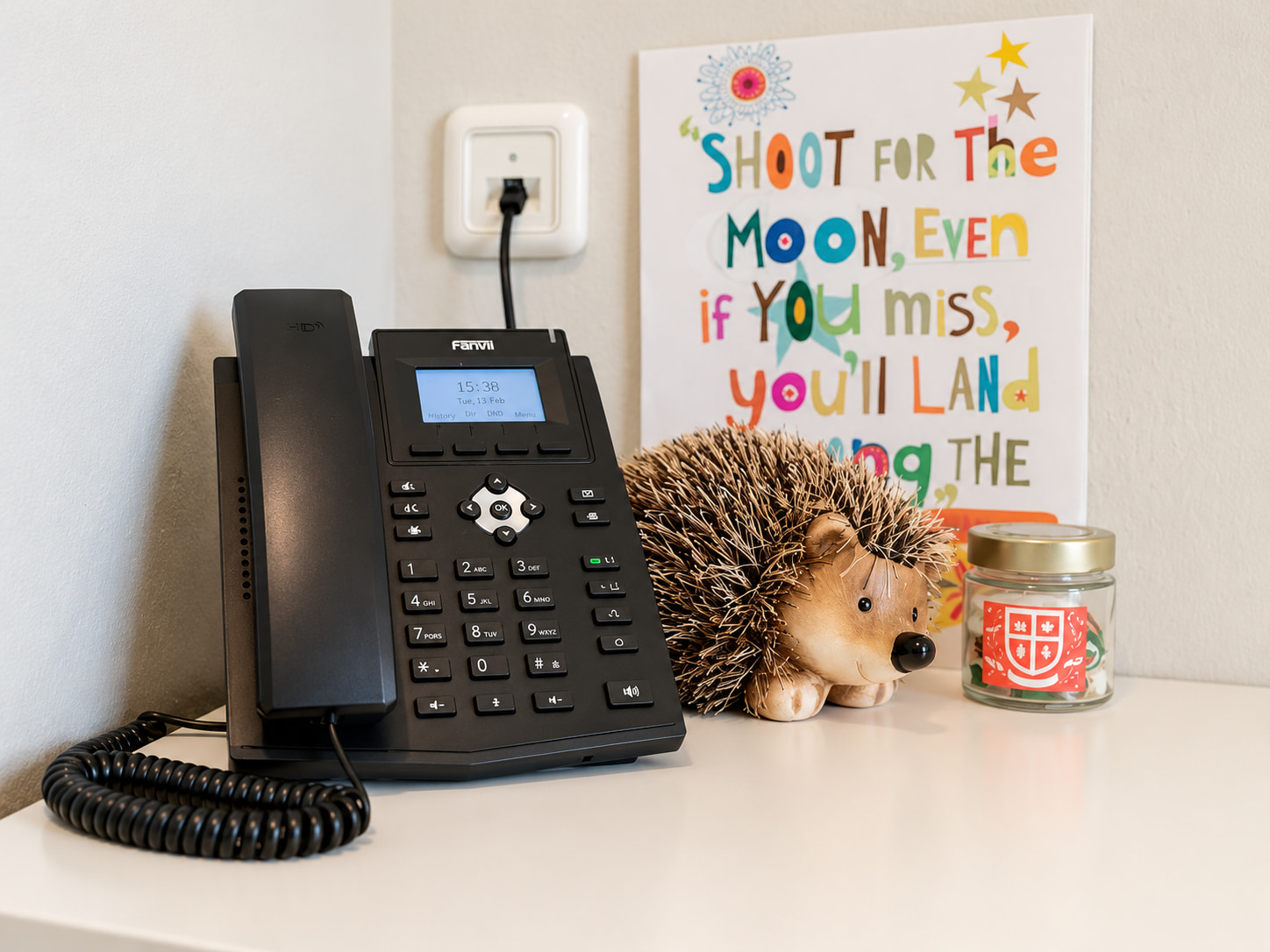
An IP phone in a boarding room at Schloss Krumbach International School. Every room has one for contacting parents on the phone-free campus.

Phone-free does not mean cut off from family. Students have unlimited IP telephone calls free of charge, and each student has two scheduled opportunities every week for Zoom video calls with family. Parents can also contact the Boarding Team whenever necessary.

Before term begins, families should agree a practical call routine that works across time zones, especially during the first weeks of boarding.

The Year After Arrival: Five Round Trips and a Renewal

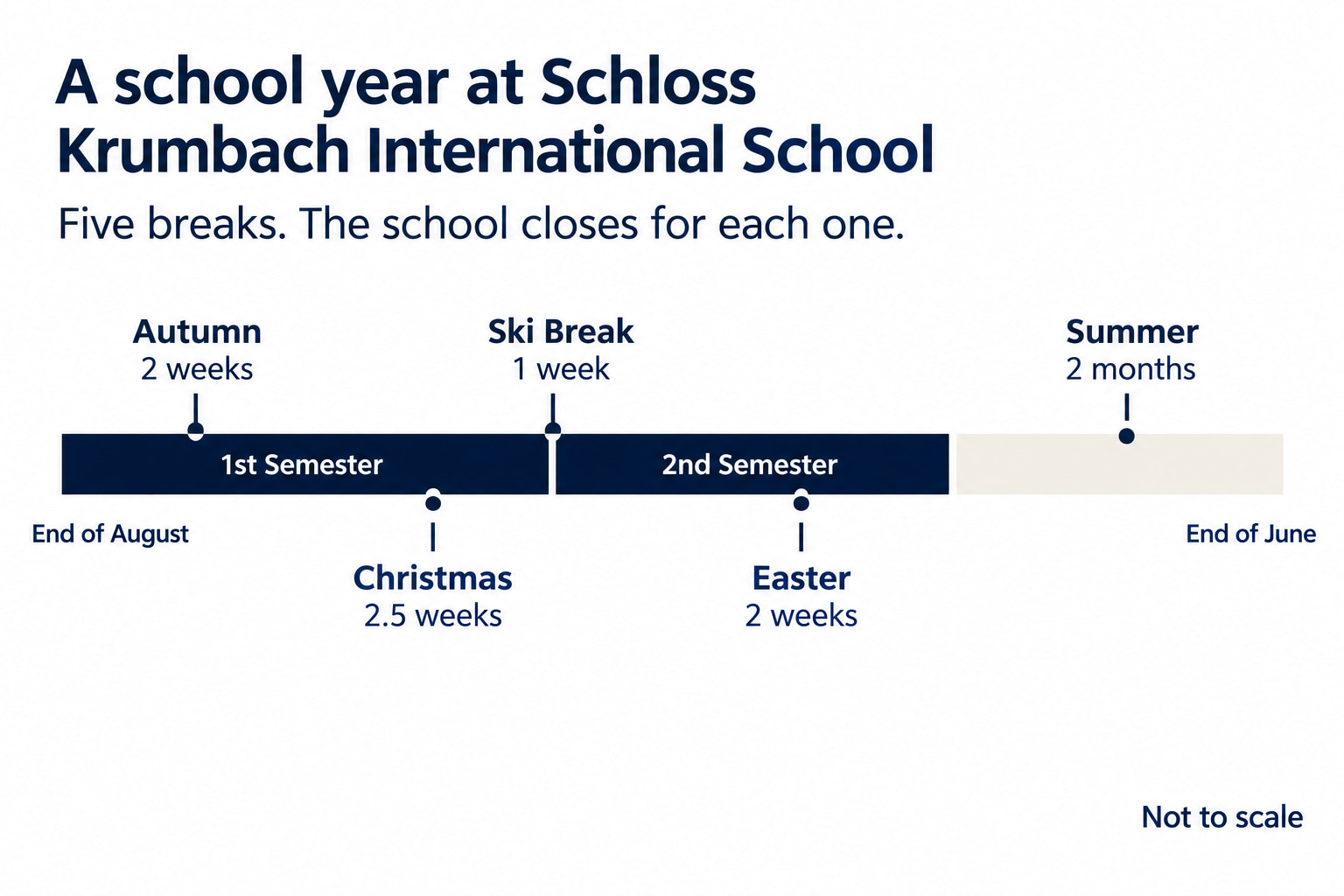
At SKIS, the school year runs from the end of August to the end of June, and the school closes for every break.

Break at SKISLength
Autumn2 weeks
Christmas2.5 weeks
Ski Break (between semesters)1 week
Easter2 weeks
Summer2 months

Families should plan for repeated travel throughout the academic year. A typical cycle includes the student’s initial journey to school, a departure and return for each of the four major mid-year breaks, and the final journey home for summer. In other words, there can be ten one-way journeys across a full academic cycle if the student returns home for every break.

The Aufenthaltsbewilligung – Schüler is normally issued for up to 12 months. A renewal application must be made before the current permit expires and can be submitted no earlier than three months before expiry. Renewal also requires evidence of school success from the previous school year. For a minor, families should confirm with the competent authority and SKIS which adult must appear for the application.

Ask the school which document serves as that evidence. Year strip of the Schloss Krumbach International School calendar from the end of August to the end of June, in order and not to scale. Autumn break 2 weeks, Christmas break 2.5 weeks, a 1-week Ski Break between the 1st and 2nd Semester, Easter break 2 weeks, then a 2-month summer break. The school closes for each break.
Before Moving Your Child to School Abroad: Questions for the School

  1. Which school documents will SKIS provide for our child’s residence-permit or EU-registration process?
  2. Who can be named as the adult responsible for my child’s care and upbringing in Austria?
  3. Who handles the student’s Austrian address registration after arrival?
  4. Which parts of the visa and residence process does Admissions support, and which parts remain the family’s responsibility?
  5. What health insurance does our child need for their nationality and residence status?
  6. How should arrival, airport transfers and travel during school breaks be coordinated?

Your household stays put. With these six answers in writing, you know which rows of this relocation checklist for international families are yours. Send the six questions to Schloss Krumbach International School at info@krumbach.school, or contact the Admissions Team.

Frequently Asked Questions

No. Moving your child to school abroad as a boarder relocates only the child; the family home stays put. Schloss Krumbach International School is full boarding only and closes for every break, so families plan where their child spends each one.

A non-EU/EEA/Swiss child at school in Austria for over six months needs a residence permit for pupils, generally sought abroad at an Austrian embassy or consulate. EU, EEA and Swiss children need no visa or permit and obtain a registration certificate within four months of arrival. Each family confirms its own case with the Austrian embassy or consulate.

For minor pupils applying for an Austrian residence permit, the authorities require evidence that an adult resident in Austria has been entrusted with the child's care and upbringing.

For SKIS boarding students whose parents live abroad, the School Principal, Teresa Schnabl, acts as the school's appointed local guardian during the student's time in Austria. Families should coordinate the required documentation with Admissions before submitting the residence-permit application.

Students at SKIS do not use personal mobile phones during everyday school and boarding life. Each student has access to unlimited IP telephone calls free of charge and two scheduled Zoom opportunities with family each week. Parents can also reach the Boarding Team at boarding@krumbach.school and receive regular reports.

This answer is Schloss Krumbach International School's own, as the school publishes it.

Applications are accepted throughout the year, although we strongly recommend applying as early as possible. This gives enough time for academic assessment, campus visits, language preparation and enrolment arrangements. International families may also need additional time for visa or residence-permit procedures before the student can begin school in Austria.

About the Author

Admissions at Schloss Krumbach International School in Krumbach, Austria. Her areas are the admissions process, placement tests, entry requirements, and visa support for international families. She wrote this guide to put the school year ahead of the birthday.

Explore
Drag
Schloss Krumbach International School
Privacy Overview

This website uses cookies so that we can provide you with the best user experience possible. Cookie information is stored in your browser and performs functions such as recognising you when you return to our website and helping our team to understand which sections of the website you find most interesting and useful.