Are Boarding Schools Safe? Supervision and Wellbeing
Updated: October 2026
“Are boarding schools safe?” is rarely a question about locks and cameras. Parents asking it want to know whether their child will be in good company, far from home, with adults who notice.
This guide is for parents weighing a boarding school abroad for a child aged 12 to 18. It covers peer culture, rule enforcement, night supervision, wellbeing and published safety standards. It does not rank schools, cover therapeutic or special-needs boarding, or give legal advice.
Are Boarding Schools Safe? The Short Answer
Boarding schools are as safe as the individual school makes them. On wellbeing, motivation and engagement, boarding shows no average penalty: a 2014 study of 5,276 students at 12 Australian schools found boarders and day students broadly level.
Boarding carries its own risks: boarders depend on adults day and night, and children whose parents live overseas are especially vulnerable (Independent Inquiry into Child Sexual Abuse, 2022, covering England and Wales).
Five checks tell a safe boarding school from an unsafe one. Two concern the community: who the school admits and how it enforces bans on alcohol, vaping and drugs. Three concern the adults: who is responsible at night, whether staff always know where each child is, and whether adults know each child personally. England’s boarding standards require an adult sleeping or on duty in each boarding building at night.
A parent can test whether a boarding school is safe by asking for a named person, a written rule or something visible on a visit. Boarding abroad adds four checks: private contact across time zones, travel arrangements, holiday plans and educational guardians.
Key takeaways
- The school, not boarding itself, decides how safe a child is.
- Admissions decides the company your child keeps every day.
- A published ban means little until you see it enforced.
- Ask who is responsible for your child at 2am.
- A boarder needs an adult to confide in outside the school’s staff.
Jump to: Evidence · Four risks · Peer culture · Enforcement · Night · Wellbeing · Far from home · One school · Signs and red flags · FAQ
How Safe Are Boarding Schools? What the Evidence Shows
Martin, Papworth, Ginns and Liem (American Educational Research Journal, 2014) surveyed 5,276 students at 12 Australian schools, 28% of them boarders, controlling for background, achievement and personality. Boarders and day students showed predominant parity on motivation, engagement and wellbeing, with modest advantages for boarders in life satisfaction and parent-child relationships. The limit: an Australian sample, followed for one year.
The Independent Inquiry into Child Sexual Abuse reached a harder verdict. Its residential schools report of 1 March 2022, covering England and Wales, concluded that schools “are not as safe for children as they should be”.
So how safe are boarding schools? In one large study boarders did no worse on wellbeing, and the documented risks are real. The useful question is not “are boarding schools safe?” but “is this school safe for my child?”
Four Risks Boarding Concentrates, and How to Test Each
Safeguarding is the framework of policies, staff training, vetting and procedures that protect children from harm, abuse and neglect at school. In boarding schools, safeguarding extends around the clock and covers residential life, trips and online activity.
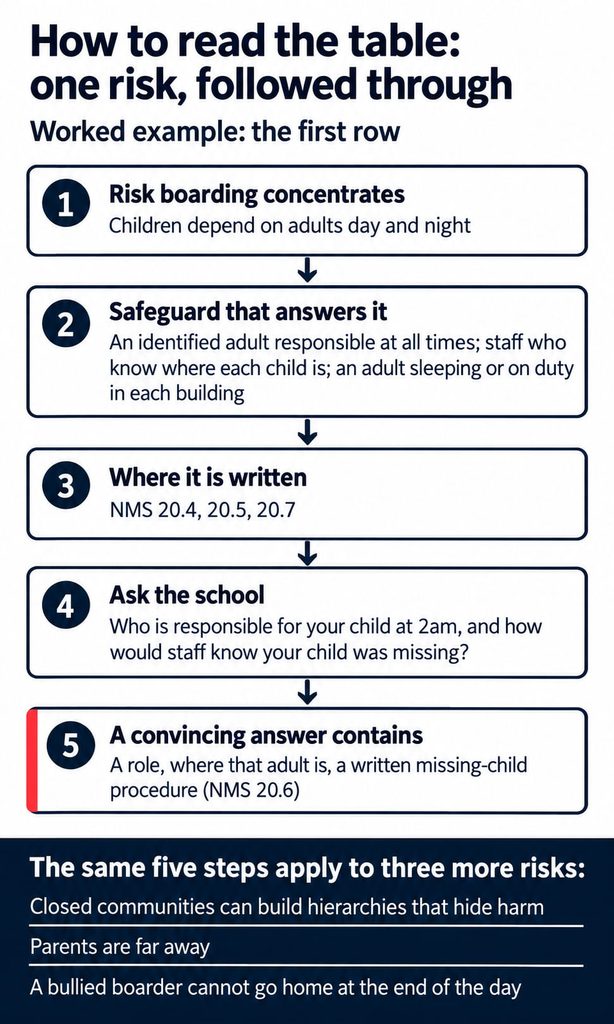
Boarding concentrates four risks a day school dilutes: dependence on adults, hierarchies that can hide harm, distance from parents and no escape from a bully. The Independent Inquiry into Child Sexual Abuse documented the first two in 2022 and found children with parents overseas especially vulnerable. England’s National Minimum Standards for Boarding Schools (NMS) name the fourth in standard 16.3.
The table borrows two national yardsticks any parent can use: the NMS (Department for Education, in force since September 2022) and Austria’s school regulations, the Schulordnung 2024.
| Risk boarding concentrates | Safeguard that answers it | Where it is written | Ask the school | A convincing answer contains |
|---|---|---|---|---|
| Children depend on adults day and night | An identified adult responsible at all times; staff who know where each child is; an adult sleeping or on duty in each building | NMS 20.4, 20.5, 20.7 | Who is responsible for your child at 2am, and how would staff know your child was missing? | A role, where that adult is, a written missing-child procedure (NMS 20.6) |
| Closed communities can build hierarchies that hide harm | An “independent person” outside staff and leadership whom children contact directly; supervised prefects (senior students with supervisory duties); a code of conduct and child protection team | NMS 11.4, 21.1; Schulordnung 2024 | Who can your child talk to who does not work for the school? | A name, how children reach that person, a code of conduct you can read |
| Parents are far away | Private contact across time zones; written travel arrangements; vetted guardians | NMS 12.1, 11.2, 22.1 | When can your child call you privately, and who is responsible on the journey home? | A contact routine, a written travel plan, a named boarding contact |
| A bullied boarder cannot go home at the end of the day | An anti-bullying strategy written for boarding; at least two outside support services | NMS 16.3, 11.5 | What happens on the evening a child reports bullying? | Who acts that night, the next steps, when parents are told |
Austria’s 2024 school regulations describe a child protection concept. It has four parts: a code of conduct, a risk analysis, a child protection team of at least two people and a procedure for suspected danger. The regulation also requires a review at least every three years, as the Austrian Federal Ministry of Education’s 2024 guide explains. A parent can ask to read the code of conduct.
On every row, a convincing answer is a name, a document, or something you can see; a slogan such as “our students are never alone” is not.
Bad Company Far From Home: Peer Culture as a Safety Question
What most parents fear is rarely boarding itself. It is the company a child keeps with no parent nearby. Admission decides that company, and policies vary. Some boarding schools take any applicant who can pay; others interview the child and the family, weighing behaviour and values as well as marks.
Hierarchy matters as much as intake. England’s standards require any prefect system to have staff supervision, training and checks against abuse of the role. How older students treat younger ones is one of the clearest signals of a culture.
Bullying in boarding schools weighs heavier because a boarder cannot leave a bully behind at the end of the day. Ask who acts on the evening a child reports it.
On a visit, watch for four things:
- How older students speak to younger ones
- Whether students talk freely once the guide steps away
- How a new student is introduced, and by whom
- Whether admissions asked about behaviour and family values, or only marks
Rules on Paper, Rules in Practice: How Enforcement Shows
A ban on alcohol, vaping and drugs is easy to publish. Enforcement is where schools differ, and it separates a substance-free campus from a substance-free brochure.
| The policy says | What shows it is real |
|---|---|
| Alcohol, vaping, smoking and drugs are prohibited | Ask if belongings are checked, how families are informed about the procedure, what happens after a breach, and when parents are contacted |
| Phones are restricted | You can see where phones are kept at night and how a child calls home privately |
| Students do not leave campus alone | A sign-out record exists; staff can say who was off site last Saturday |
| Weekends are structured | A written weekend programme with a named adult on duty |
| Breaches have consequences | The school states what follows a first and second breach, what ends a place, and when parents are told |
If a school answers “each case is different”, ask about the last case.
Since 1 May 2025, an Austrian Federal Ministry of Education regulation has barred pupils up to and including Grade 8 from using mobile phones in school. A child’s own phone can be a route for cyberbullying, contact with strangers and social-media pressure.
Removing it closes that route – and the child’s private line home. So ask how private contact with parents works instead: how often, from where, and who else can hear.
Who Knows Your Child at 2am? Night Supervision and Whereabouts
Pastoral care is the structured system through which a school looks after students’ emotional, social and physical wellbeing — through houseparents, tutors, counsellors and health staff. On a school website, the phrase should mean a named adult who knows your child and is responsible at night.
England’s National Minimum Standards for Boarding Schools set a five-point floor:
- An identified, suitably qualified and experienced member of staff is responsible for boarders at all times (20.4).
- Staff know where every boarder is, or how to find out (20.5).
- Staff follow a missing-child procedure and actively search (20.6).
- At least one adult sleeps or is on duty in each boarding building at night (20.7).
- Boarders know how to reach that adult (20.8).
Formal supervision counts heads; genuine supervision means the adult on duty knows the child. Would that adult notice three skipped breakfasts, or a change in mood? Ask about Saturday as well as Tuesday. In our view this 2am test tells a parent more than a brochure, though no single answer settles it.
Wellbeing: Sleep, Food, Health and Someone to Talk To
One in seven 10-19-year-olds worldwide experiences a mental disorder, according to the World Health Organization’s 2025 fact sheet.
The American Academy of Sleep Medicine’s 2016 advisory recommends 8 to 10 hours of sleep a day for ages 13 to 18. Ask about bedtime routines, where devices are kept at night, and for a full week’s menu and timetable.
Health needs the same scrutiny. Ask who decides when a child sees a doctor, who stays with a child who is unwell at night, and when parents are told. A school that answers with roles and a written procedure has thought it through.
England’s National Minimum Standards require schools to give boarders details of at least two child-specific support services outside the school. These come on top of the independent person children can contact directly. A simple test of boarding school wellbeing is whether your child could name both routes without asking staff.
For homesickness, ask how new boarders are helped through their first weeks.
When Home Is Far Away: What International Families Should Check
Are boarding schools safe for a child whose parents live overseas? The Independent Inquiry into Child Sexual Abuse (2022) found such children especially vulnerable, and their educational guardians little regulated. An educational guardian is an adult in the school’s country who acts for the family. Distance adds four things to check.
- Travel: England’s standards require clear travel arrangements for international pupils each term. Ask who meets your child and who is responsible en route.
- Private contact across time zones: the same standards require private contact with family at times that suit both sides. A child who can talk freely can report a problem, so boarding school parent communication is a safety check as much as a comfort.
- Holidays: some schools close completely during breaks. Plan where your child will stay before term starts.
- Educational guardians: guardians appointed by the school undergo the same safer-recruitment checks as staff. Ask who vets one you appoint yourself.
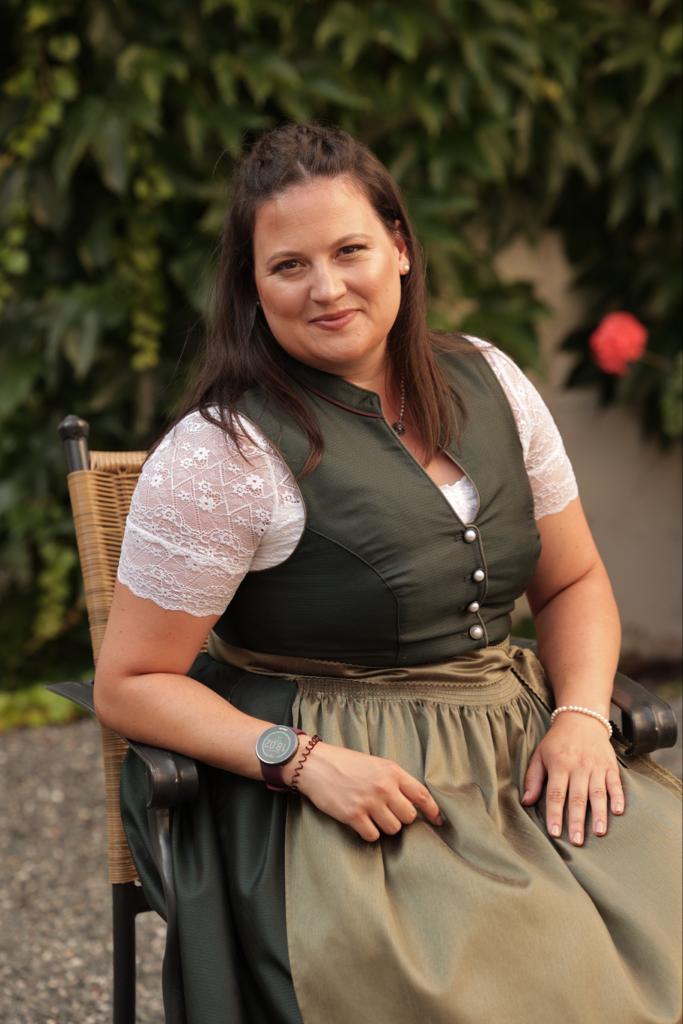
At SKIS, families do not need to rely on a separate external guardianship service during term time. The School Principal, Teresa Schnabl, acts as the school’s appointed local guardian for boarding students whose parents live abroad.
One School’s Answers: Schloss Krumbach International School
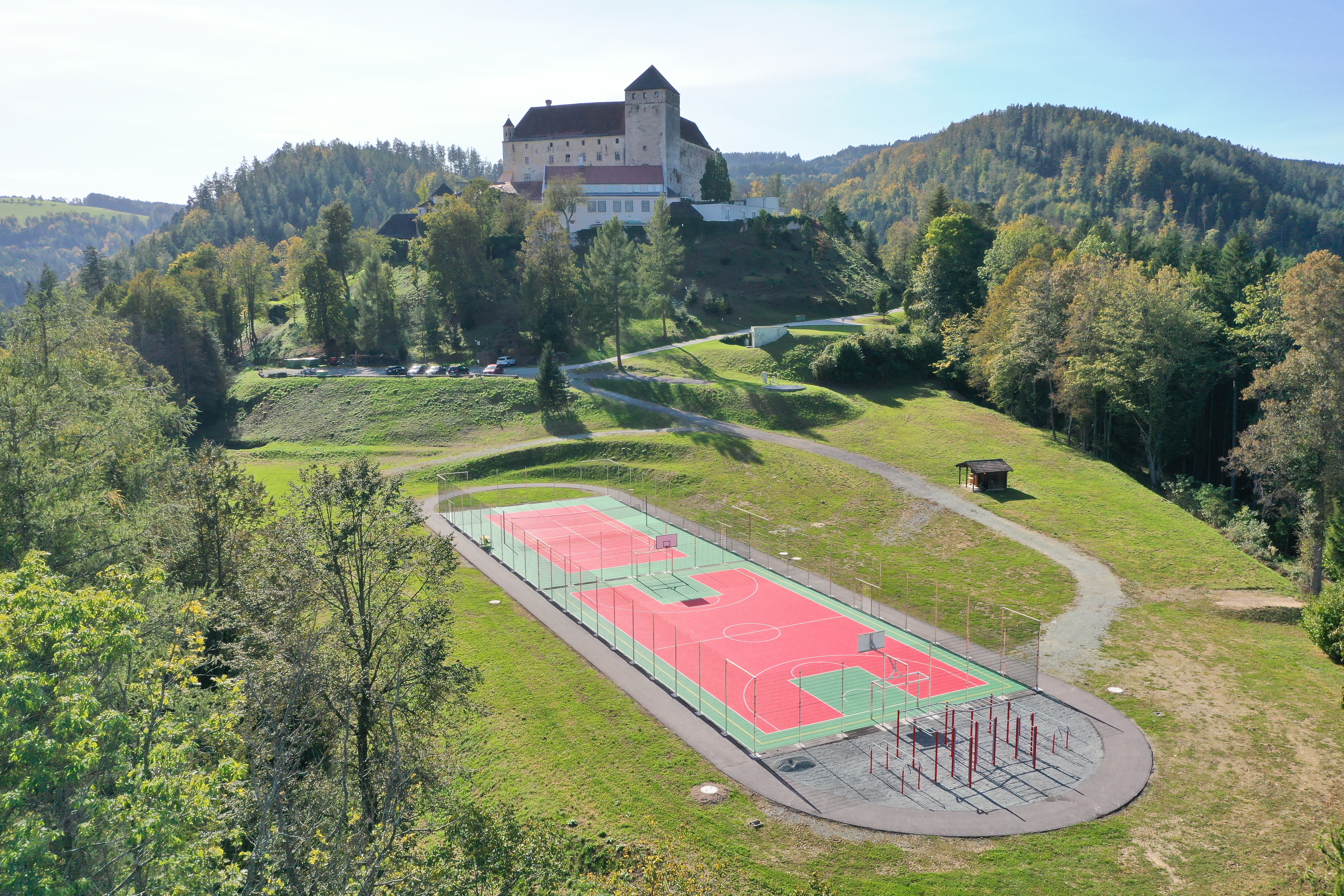
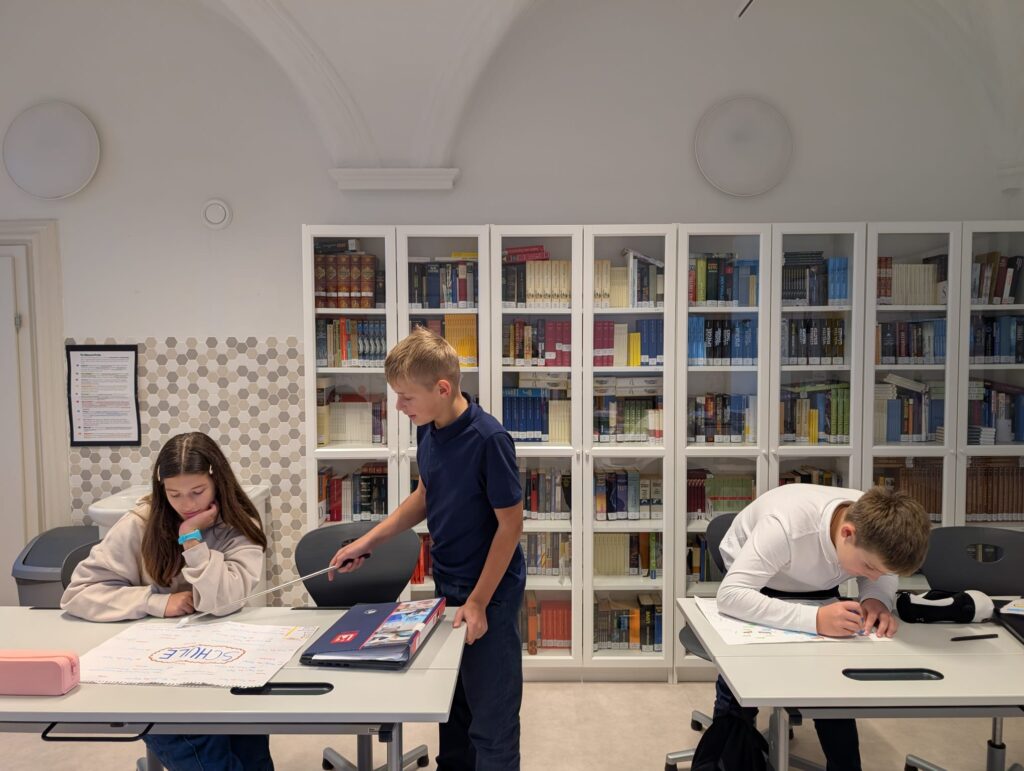
Schools answer these questions differently, above all on admissions, enforcement and supervision. Here is how one school, Schloss Krumbach International School (SKIS), answers them; its boarding policy on supervision and student welfare is public.
- Who joins the community: Admissions considers academic readiness, language level, motivation, willingness to learn and readiness for the SKIS boarding environment. The student’s own wish to join also matters. Because students live together as well as study together, personal fit is part of the admissions decision.
- Prohibited substances and items: Alcohol, tobacco, vaping products and drugs are prohibited. Unauthorised personal electronic devices are also restricted.
- Belongings and luggage: Students’ belongings and luggage are checked as part of the school’s established safeguarding and boarding procedures to prevent prohibited items from entering the school. Families are informed about this procedure before arrival.
- Residential life: Boys and girls live in separate residential areas with clear boundaries around access, privacy and student rooms.
- Local guardianship: For boarding students whose parents live abroad, the School Principal acts as the school’s appointed local guardian during the student’s time in Austria. This gives families a named senior adult with direct responsibility for the child rather than relying on an external guardianship service.
- Trips and time off campus: School trips and excursions are accompanied by responsible adults. Weekends remain within the supervised boarding rhythm, while still including free time, reading, sport and other activities.
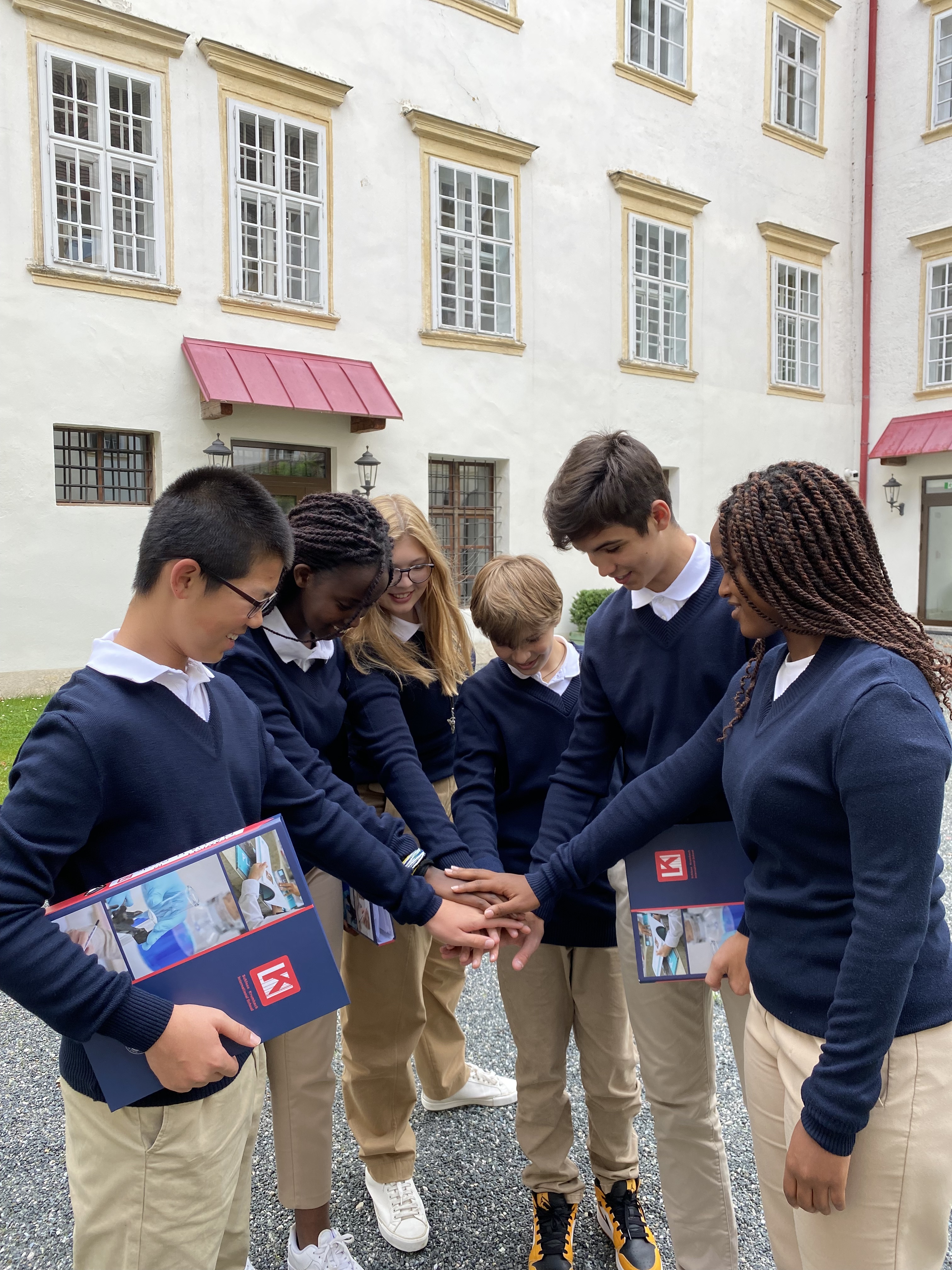
- Students are known personally: SKIS is deliberately small, with a maximum of 10 students per class. Teachers and boarding staff see students across lessons, supervised study, meals, activities and residential life, making changes in behaviour, confidence or academic progress easier to notice.
- Bullying and speaking up: Bullying, intimidation and harassment are not accepted at SKIS. Because the school community is small, teachers and boarding staff see students across lessons, study time, meals, activities and residential life, making changes in behaviour or relationships easier to notice. Students have several routes for raising a concern and can speak to a teacher, Department Head or the School Principal. Serious safeguarding concerns are escalated through the school’s child protection procedures. Grade representatives and older students can also help a student find the appropriate adult when support is needed.
- Older and younger students: Older students help younger students and newcomers understand routines and expectations. Grade representatives and student leadership also form part of the community structure.
- Phone free, but connected to family: Students do not use personal smartphones during everyday school and boarding life. School technology remains available for academic purposes. Students have unlimited IP telephone calls and two scheduled Zoom opportunities each week, and parents can contact the Boarding Team when necessary.
What does supervision look like beyond rules?
At SKIS, supervision is not limited to cameras, gates or a list of prohibited items.
Teachers and boarding staff know students across different parts of the day. They see them in class, during supervised homework, at meals, on walks, during activities and in residential life. This matters because safety also depends on noticing change. A student may become unusually quiet, stop eating normally, lose confidence, fall behind academically or withdraw from friends before they ever formally report a problem. The small school environment makes it easier for adults to notice those changes and respond while the problem is still manageable.
Full boarding is the only model at SKIS. Students live, study, eat, rest and take part in school life within one structured residential environment. The week includes lessons, supervised homework, meals, sport, outdoor time, reading, activities, evening routines and free time. Weekends are more relaxed, but still combine supervised academic preparation with reading, activities and personal time. For parents comparing boarding schools, this means supervision should be judged across the whole week, not only during lessons.
What happens when a student is unwell?
Boarding safety also includes ordinary health care. At SKIS, boarding staff care for and monitor students who are unwell. When necessary, students can access local medical care in Krumbach or Landesklinikum Wiener Neustadt. Separate rest rooms are available when a student needs to recover away from others. Medication is handled according to school procedures, and parents are kept informed when medical concerns arise.
Admission is selective, through assessments and family interviews, because the peer environment matters in a boarding school. SKIS considers academic readiness, motivation and personal fit alongside the student’s willingness to join and participate in the community. Older students are expected to support younger students and newcomers, while learning, reading, preparing properly and taking school seriously are intended to feel normal within the peer culture.
This is one of the strongest safety elements in place at SKIS. For a boarder, who surrounds your child is part of safeguarding too.
The school and boarding campus close during holidays, when all students leave campus, so each family plans where the child goes.
The transition to a phone free environment can take adjustment, particularly for new students. The purpose is not to remove technology from education, but to protect concentration, reading, conversation, friendships and independent thinking while still providing school technology for academic work.
As one SKIS student put it: “At first it was difficult, but at the same time very refreshing. The moment my phone was gone, I felt like the number of hours in a day doubled.”
Safe, or Just Saying So? Reassuring Signs and Red Flags
| Area | Reassuring sign | Red flag |
|---|---|---|
| Night | A named role on duty in each building, awake or reachable | “24/7 care” with no name or procedure behind it |
| Whereabouts | A sign-out system and a written missing-child procedure | No one can say who was off site last weekend |
| Rules | A written prohibited items policy, a standard luggage check procedure and clear consequences communicated to families | Bans listed, but no one can say what follows a breach |
| Peer culture | Staff-supervised prefects; the family interviewed at admission | Any applicant admitted, whatever their behaviour or fit; initiation rituals called “tradition” |
| Someone to talk to | Several clearly explained reporting routes, including adults in both academics and boarding as well as student leadership peers | A student has only one person or one chain of command through which every concern must pass |
| Contact | Private, regular calls planned around time zones | Calls only when staff decide, or with staff listening |
| After enrolment | Reports that cover behaviour as well as grades | Parents hear only good news |
For your child, the answer to “are boarding schools safe” sits in these seven rows, not the brochure. Take the table to each visit and put the 2am question to every school. Families considering Schloss Krumbach International School can put the same questions to the school directly, starting with who is responsible for their child at night.
Frequently Asked Questions
Are boarding schools safe for international students far from home?
Boarding schools can be safe for international students, but distance adds risk: the Independent Inquiry into Child Sexual Abuse (2022, covering England and Wales) found children whose parents are overseas especially vulnerable. Ask how private calls, travel and guardianship work, because on all three the school is the variable.
Does boarding harm a child’s mental health?
In a 2014 study of 5,276 Australian students, boarders did no worse than day students on wellbeing, on average. The World Health Organization reports that one in seven 10-19-year-olds experiences a mental disorder, so support matters at any school. A boarder should be able to name someone to talk to, including an adult outside the staff.
Can boarding school students leave campus on their own?
Whether a boarder may leave campus alone depends on written school rules, which vary by school and age. England’s National Minimum Standards for Boarding Schools require staff to know, or be able to find out, where every boarder is at all times. A written sign-out rule and a named adult on every trip are what to ask for.
The following answers describe how these areas work at Schloss Krumbach International School.
How do you keep the campus safe?
Safety at SKIS combines clear rules, adult supervision and a small residential community in which students are known personally.
Alcohol, tobacco, vaping products and drugs are prohibited, as are unauthorised personal electronic devices. Students’ belongings and luggage are checked as part of the school’s established safeguarding and boarding procedures to prevent prohibited items from entering the school, and families are informed about this procedure before arrival.
Boys and girls live in separate residential areas, and trips and excursions are accompanied by responsible adults.
Safety also means noticing when something changes. Teachers and boarding staff see students throughout academic and residential life, making it easier to respond when a student needs academic, emotional or practical support.
How are parents kept informed about their child’s progress?
We see parents as important partners in both academic and boarding life. Students’ progress is monitored closely, and families receive regular communication about academic development, achievements and any concerns that arise. Our small classes and small residential community also allow communication between staff and families to remain personal and individual.
Can my child contact us regularly from boarding school?
Yes.
A phone free campus does not mean children are cut off from their families. Students at SKIS have unlimited IP telephone calls and two scheduled opportunities for Zoom calls with family each week.
Parents can also contact the Boarding Team when necessary.
Regular family contact is particularly important during the first weeks of boarding, illness or a period of homesickness.
What happens if my child becomes ill at boarding school?
Boarding staff care for and monitor students who are unwell.
When necessary, students can access local medical care in Krumbach or at Landesklinikum Wiener Neustadt. Separate rest rooms are available, medication is handled according to school procedures, and parents are kept informed.
About the Author
Teresa Schnabl is School Principal at Schloss Krumbach International School, a boarding school for Grades 7-12 in Krumbach, Austria. She contributes to academic and daily school leadership, communication with families and the organisation of school life.