Skip links
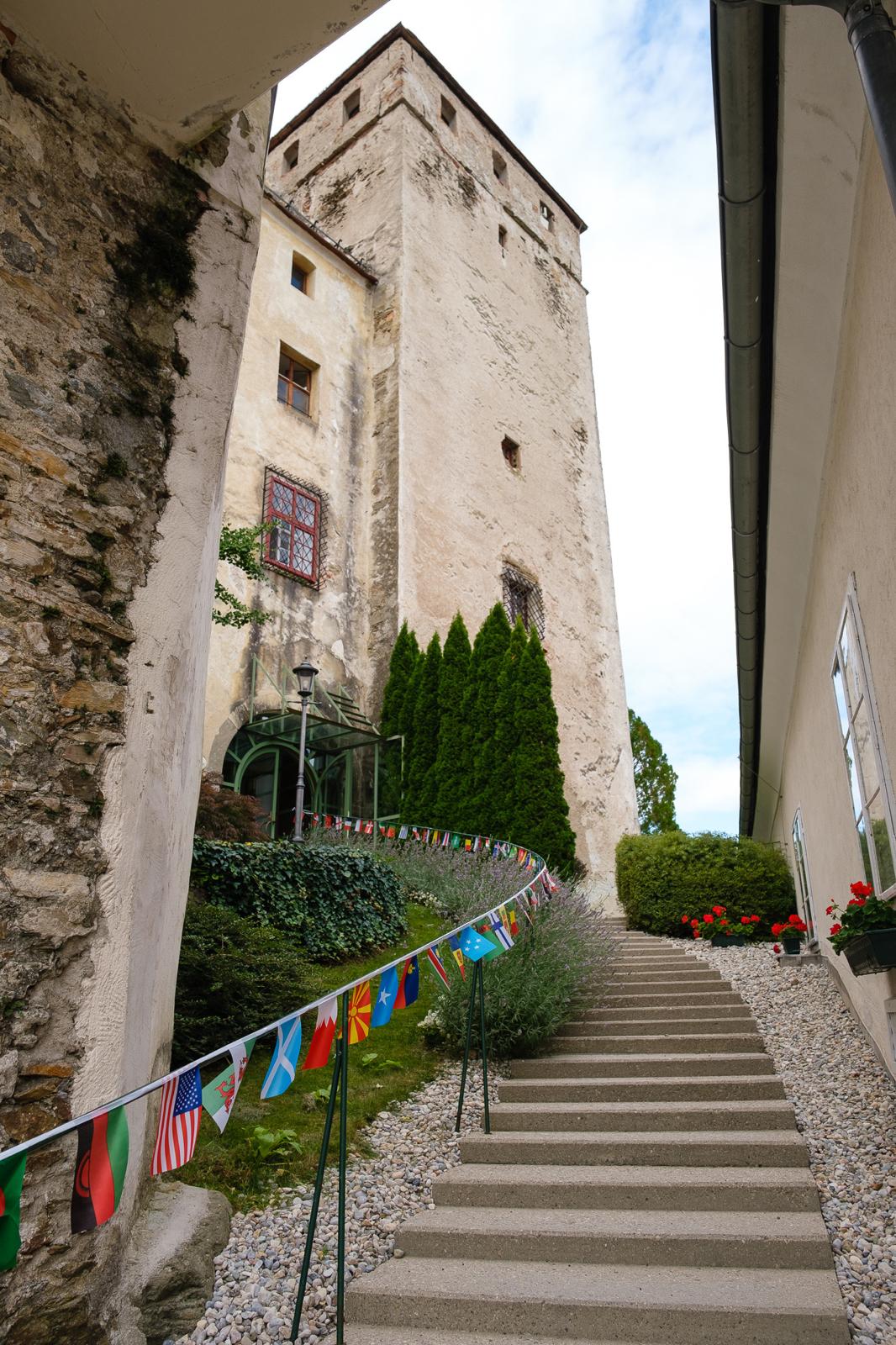
The 13th-century Schloss Krumbach castle in Austria, home of Schloss Krumbach International School, whose school year starts at the end of August

Student Visa Timelines: A Backwards-Planning Calendar for the School Year

Search “austria student visa processing time” and the figures you find apply to university students, not school pupils. For parents outside the EU planning a boarding-school year in Austria, this plan counts back from an end-of-August start.

This guide explains published Austrian rules, not legal advice; each family confirms its own case with the Austrian embassy or an immigration adviser.

Austria Student Visa Processing Time for School Pupils: The Short Answer

Children from outside the EU, the European Economic Area and Switzerland need a residence permit for pupils, not just a visa, for a school year in Austria.

Austria’s Federal Ministry of the Interior (BMI) says residence permit applications are decided no later than six months after receipt. The 90-day decision period published for the residence permit for university students does not apply to school pupils.

For an end-of-August school start, a cautious plan files the complete permit application at the Austrian embassy or consulate by mid-to-late January. A decision can come before the six-month limit, but Austrian law sets no shorter limit for pupils.

Key takeaways

Austria Residence Permit for Pupils: Why a Visa Alone Is Not Enough

A boarding-school year that runs from late August to late June lasts about ten months. Austria’s official portal, oesterreich.gv.at, says stays over six months need a residence permit, unless EU law grants the right to stay.

The residence permit “pupil” (Aufenthaltsbewilligung – Schüler) is the Austrian residence title for attending a qualifying school. The legal basis is § 63 of the Settlement and Residence Act (NAG). The portal says the permit is usually issued for up to twelve months.

Where an entry visa is required, the Austrian embassy or consulate issues a Visa D after the residence application has been approved. A child who is entitled to enter Austria without a visa may instead travel visa-free and collect the residence card in Austria.

EU, EEA and Swiss pupils need no residence permit. For stays over three months, they apply for a registration certificate (Anmeldebescheinigung) within four months of entry.

The qualifying schools, listed in § 63 NAG, include public schools and private schools with public-law status (Öffentlichkeitsrecht). Ask every school which § 63 category its enrolment confirmation falls under, and whether its pupils have held this permit before.

Schloss Krumbach International School has Austrian public rights, Öffentlichkeitsrecht, and therefore falls within the category of recognised private schools whose pupils may qualify for the Residence Permit – Pupil, provided the individual applicant meets the other legal requirements.

Why a Pupil's Permit Can Take Six Months, Not 90 Days

Most guides to Austria student visa processing time are written for university students, whose 90-day period is a real figure for another permit.

Austria’s interior ministry (BMI) says decisions come no later than six months after receipt. Shorter limits cover only listed permits.

The pupil permit is not listed, so the general six-month limit applies.

PermitDecision period set in lawPublished by
Residence permit “pupil” (school pupils)No shorter period listed: the general limit of six months appliesBMI
Residence permit “student” (university students)90 days, extended by a further 90 days if documents must be addedBMI; OeAD


A school pupil has no 90-day limit to rely on; a university student does, before any extension. Six months is the legal limit, not a forecast. The Austrian Business Agency’s general guidance says residence applications usually take several weeks, but it gives no figure for pupils.

BMI says a first application is filed in person at the embassy responsible for the family’s place of residence, as a rule by appointment (the clock starts at receipt, not at booking).

Student Visa Timeline: A Backwards Calendar From an End-of-August Start

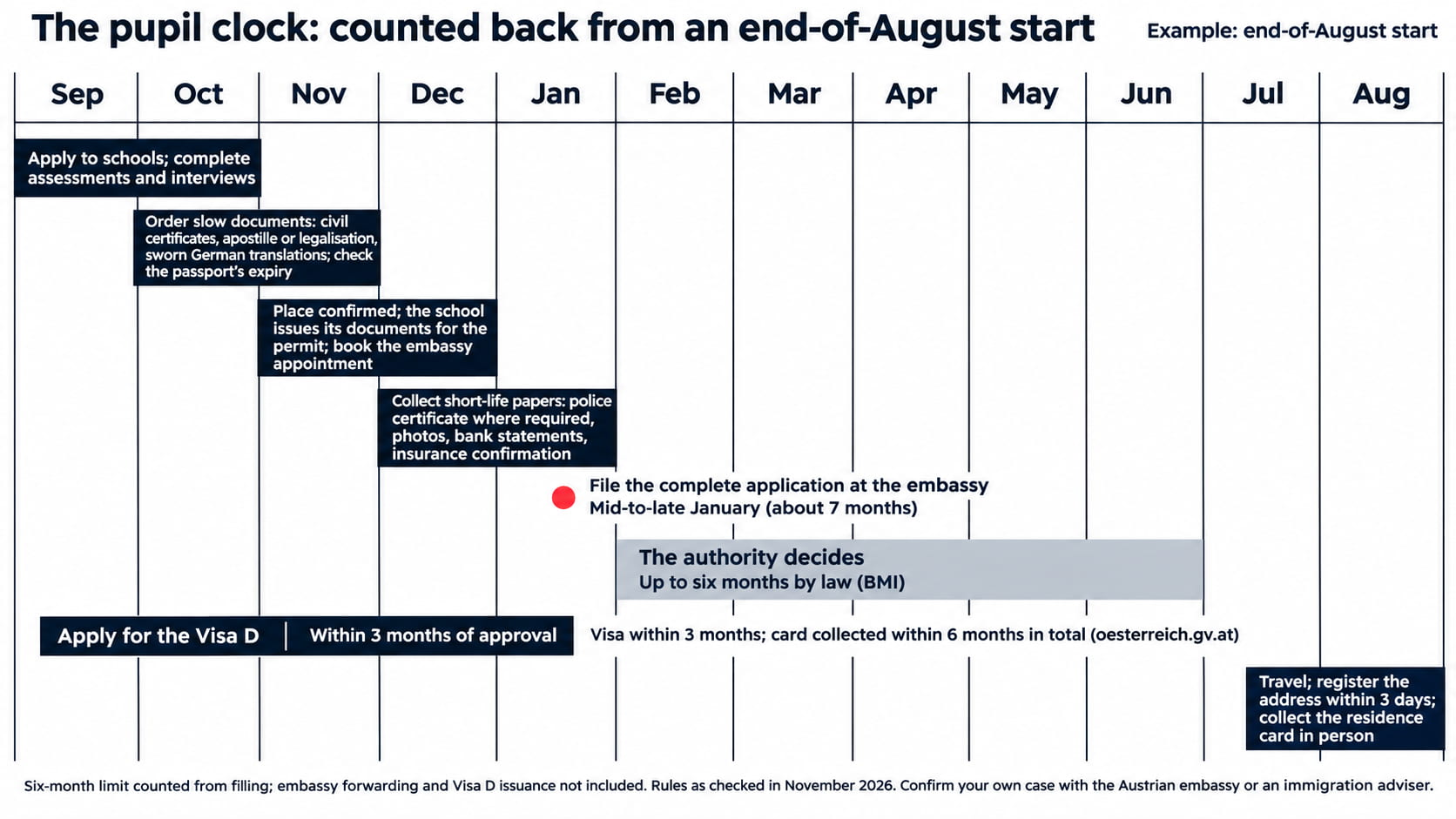
We counted back from the first day of school. We assumed the authority uses all six months the law allows, and that the period runs from filing. We call it the pupil clock.

The count leaves out embassy forwarding and the time to issue the Visa D. Ask the embassy when the period starts and how long the visa takes.

When (before an end-of-August start)StepWho actsWhy this timing
September–October (11–12 months before)Apply to schools; complete assessments and interviewsFamily, schoolThe permit file needs the school’s enrolment confirmation
October–November (9–10 months)Order slow documents: civil certificates, apostille or legalisation, sworn German translations; check the passport’s expiryFamilyLegalisation “may take several months” (OeAD)
November–December (8–9 months)

Place confirmed; obtain the school’s permit documents; for a minor, settle the care-and-upbringing documentation with the appointed adult in Austria; book the embassy appointment

For SKIS boarding students under 18 whose parents live abroad, the School Principal, Teresa Schnabl, acts as the school’s appointed local guardian in Austria. Families should coordinate the required documentation with Admissions well before the permit appointment.

School, familyFirst applications are filed in person, usually by appointment (BMI)
December–January (7–8 months)Collect short-life papers: police certificate where required, photos, bank statements, insurance confirmationFamilySome papers must be recent on the day of filing (OeAD)
Mid-to-late January (about 7 months)File the complete application at the embassyFamily, in personCounted from filing, the six-month limit ends by mid-to-late July
February–JulyThe authority decidesSettlement authority in AustriaUp to six months by law (BMI)
Within 3 months of approvalApply for the Visa DFamily, at the embassyVisa within 3 months; card collected within 6 months in total (oesterreich.gv.at)
Mid-to-late AugustTravel; register the address within 3 days; collect the residence card in personPupil; a parent or legal representative for a child under 14Registration Act; § 19 NAG
Timeline of the pupil clock for an end-of-August start in Austria: apply to schools in September–October, order slow documents in October–November, confirm the place and book the embassy appointment in November–December, collect short-life papers in December–January, file the complete residence permit application at the embassy in mid-to-late January, wait up to six months for the decision, then apply for the Visa D within three months of approval and arrive, register and collect the card in mid-to-late August.
Student Visa Timeline: A Backwards Calendar From an End-of-August Start

For an end-of-August 2027 start, the filing row falls in January 2027. Rules as checked in November 2026.

Why January, and not earlier or later?

Filed in late May, about three months ahead, a pupil’s application could lawfully stay undecided until late November.

Filing in October is not safer. A quick decision could force a trip to Austria by spring, because the residence card must be collected within six months of approval. Even after a January filing, a very fast approval can bring that trip forward.

For an end-of-August school start, this guide uses mid-to-late January as a cautious planning date for filing a complete application. January is not an official Austrian application deadline. It is calculated backwards from the general six-month decision limit so that a family is not relying on a faster decision.

Starting in November leaves about two months for the first four steps. Filing later relies on a decision faster than the legal limit; no processing time for pupils is published.
Documents: What to Start Early and What to Collect Last

Some papers take months to get; others go out of date before the appointment.

DocumentWhenWhy
PassportCheck firstA permit is issued only up to the passport’s validity (oesterreich.gv.at). Renew first if it expires during the school year
Birth certificate and other civil documentsStart earlyApostille or legalisation, then a sworn German translation; legalisation “may take several months” (OeAD)
Proof of care and upbringing by an adult living in Austria (minors)Start earlyListed for minors (oesterreich.gv.at); settle who provides it before filing
School enrolment confirmationAfter admissionIssued by the school once the place is confirmed
Proof of accommodation in AustriaAfter admissionRequired for pupils (migration.gv.at); ask the school what it can issue
Health insurance with benefits in AustriaCollect lateMust cover the stay (migration.gv.at)
Proof of means of subsistenceCollect lateRecent statements; the amount is set yearly, so the embassy confirms it
Police certificate (where required) and passport photoCollect lateOeAD (students): police certificate no older than 3 months, photo no older than 6 months

OeAD, Austria’s agency for education and internationalisation, publishes these time limits for university students (the embassy gives the exact list for a pupil).

An apostille is a single certificate, under the 1961 Hague Convention, that authenticates a public document for use in another member country. The Hague Conference on Private International Law (HCCH) lists the member countries. Documents from countries outside the Convention generally need full legalisation; the embassy confirms the route.

After Approval: Visa D, Arrival and the Residence Card

Approval starts new time limits.

BMI says the embassy then issues a visa, and the pupil travels in on a Visa D for Austria.

On oesterreich.gv.at’s pupil-permit page, the visa application is due within three months of the approval notice.

The card must then be collected from the settlement authority, the Austrian office that issues it, within a further three months, six in total.

Under § 19 NAG, the card is handed over in person, as a rule. A pupil aged 14 or over receives it personally. For a younger child, only a parent or legal representative can collect it, so plan a parent’s trip.

Austria’s Registration Act requires the pupil’s address to be registered within three days of moving in. The registration-of-residence form (Meldezettel) is filed with the local registration authority.

Austria’s general residence guidance on oesterreich.gv.at says the permit runs from its issue date, and that date, not the school calendar, sets the first renewal.

Austria Residence Permit Renewal: Check the First Renewal Against the School Calendar

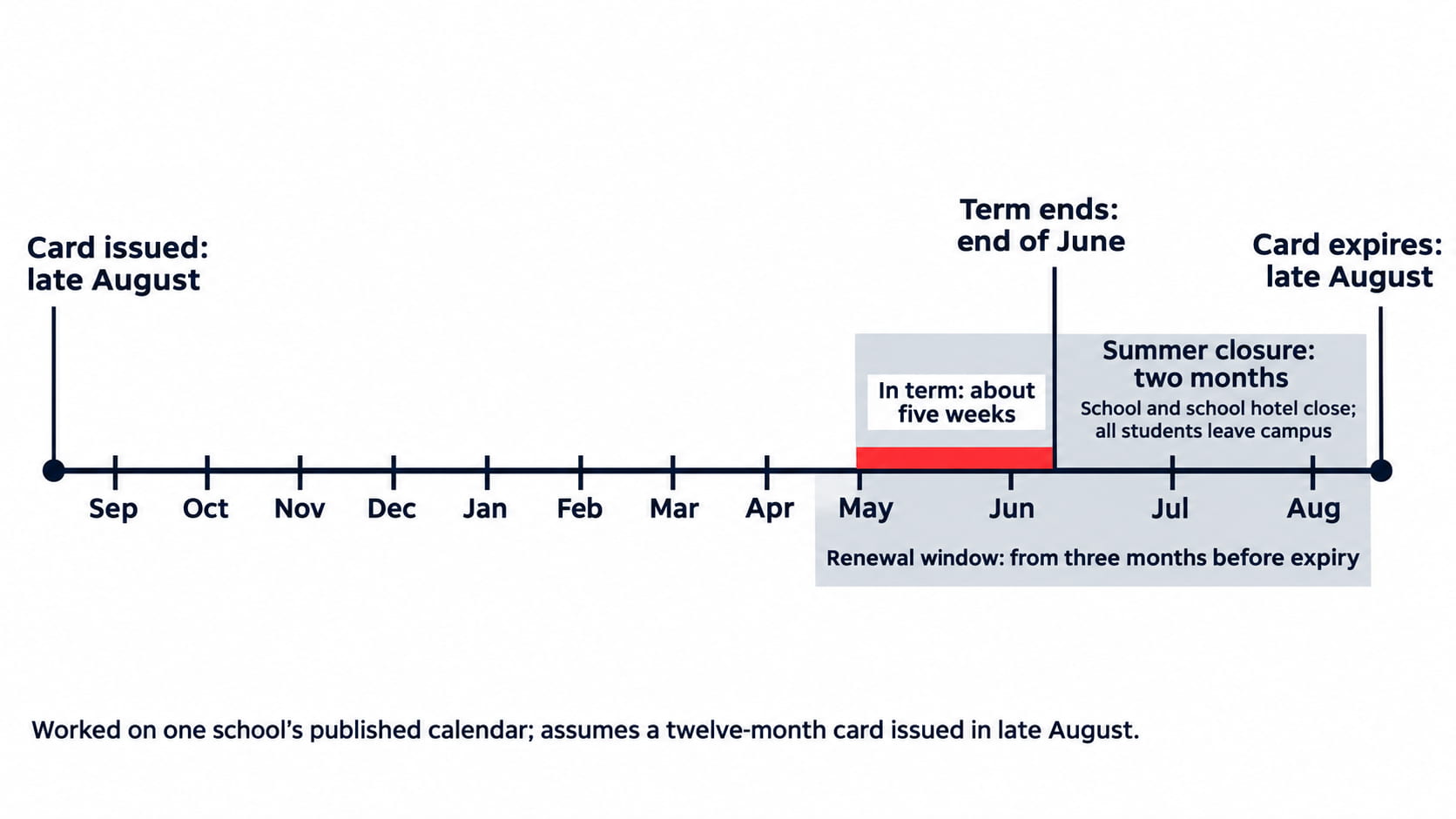
Diagram of the first residence permit renewal against the school calendar: a card issued in late August expires the following late August, so its three-month renewal window opens in late May. About five weeks of that window, from late May to the end of June, fall in term time. The rest falls in the two-month summer closure, when the school and school hotel close and all students leave campus.
Worked on one school’s published calendar; assumes a twelve-month card issued in late August.

Renewals can be filed from three months before expiry, BMI says.

File the renewal in Austria before the card expires.

A timely filing keeps the stay lawful until the decision; a late one, as a rule, counts as a first application.

Each yearly renewal needs proof of school success (§ 63 NAG).

School calendars differ: ask when the year ends and whether boarders stay over summer.

One published example: Schloss Krumbach International School’s year runs from the end of August to the end of June. The school and school hotel close for the two-month summer break, and all students leave campus. The school explains how boarding at Schloss Krumbach runs through the school year.

A twelve-month card issued in late August opens its renewal window in late May. On that calendar, about five weeks fall in term, the rest in summer.

A late-September expiry is less awkward: the pupil returns on the valid card and files in term.

Check in spring:

  1. Whether the card expires in term or summer.
  2. What proof of school success counts before the year-end report.
  3. Whether a parent or legal representative must attend (§ 19 NAG).
  4. Summer travel after filing: If a timely renewal is still pending and the student needs to travel, ask the competent authority about a Notvignette. This temporary confirmation can be placed in the passport on application, may be valid for up to three months and allows visa-free re-entry to Austria while valid. A normal confirmation that a renewal application is pending is not enough for re-entry.

Where the renewal window opens before the school closes for summer, filing during term can simplify the practical arrangements. Families should first confirm with the residence authority which evidence of school success it will accept at that point in the academic year.


Who Does What: Family, School, Embassy and Authority

Four parties are involved in a pupil’s residence process. The Austrian authorities decide the application, while the school can make a significant part of the preparation easier by providing the enrolment, accommodation and school-status documentation the family needs.

PartyIts part
FamilyGathers and certifies documents, books the embassy appointment, files in person, arranges insurance and travel, makes sure the address is registered within three days, files each renewal on time
SchoolConfirms enrolment and provides the relevant school documentation; supports the family with the school-related part of the visa and residence process; after enrolment, continues handling relevant school documentation connected with the student’s status
Austrian embassy or consulateReceives the first application; issues the Visa D after approval
Settlement authority in AustriaDecides the application, issues the residence card, decides renewals

Schools differ in what help they give beyond documents, and what the fee covers. Ask which services cost extra.

Schloss Krumbach International School publishes its own answers. We use rolling admissions, an admissions model in which applications can be considered throughout the year rather than only during one fixed application period. We encourage families who need a permit to apply early, and set out how admissions work at Schloss Krumbach.

Accepted students who need additional English or German preparation can be offered an online intensive language course before arrival. Admissions also supports families with the school-related documentation required for Austrian visa and residence procedures. This support is not listed as a separate visa-support charge. Medical insurance, airport transfers, official visa or residence fees and other personal immigration costs remain separate.

Three Dates That Set the Whole Plan

Three dates drive most of the plan above.

DateWhat it sets offRule
Mid-to-late January (for an end-of-August start)Complete application filed at the embassySix-month decision limit (BMI)
The day the approval arrivesVisa D, then the card collected within six months in totaloesterreich.gv.at
Three months before the card expiresRenewal window opens; file in Austria before expiryBMI

So what is the Austria student visa processing time for a child at school? The law allows up to six months, so the plan assumes the full limit.

These are the rules as BMI, oesterreich.gv.at and OeAD publish them, checked in November 2026, not legal advice. They change, so check your child’s case with the Austrian embassy or an immigration adviser.

Mark the first day of term, count back to the filing date and ask the embassy for its document list and appointment wait.

Frequently Asked Questions

Pupils from outside the EU, EEA and Switzerland need the Austrian residence permit "pupil". Austria's interior ministry (BMI) says the authority decides within six months at the latest. The 90-day decision period belongs to the permit for university students. A decision can come sooner, but no processing time for pupils is published.

There is no official Austrian January deadline. For an end-of-August start, this guide uses mid-to-late January as a cautious planning date because the general legal decision period can run for up to six months. Filing later may still work if the decision comes sooner, but a family should not build its school-start plan around an assumed faster processing time. Ask the embassy when it considers the application received and whether there is currently a wait for filing appointments.

First applications are filed in person at the Austrian embassy or consulate abroad, according to the interior ministry (BMI). BMI adds that people entitled to visa-free entry may file in Austria, but filing does not extend their visa-free stay. BMI's rule is general, not specific to pupils, so ask the embassy or the authority whether it applies to your child.

Renewals are filed in Austria before expiry, from three months ahead, according to the interior ministry (BMI). Late filing counts as a first application. Timely filing keeps the pupil lawfully resident until the decision. For summer travel during a timely renewal, BMI describes a one-time passport confirmation, for a fee, valid up to three months.

Yes. We support international families with the school documentation required for visa and residence-permit procedures and guide them through the preparation process from our side. Requirements vary according to nationality and individual circumstances, so families receive guidance relevant to their specific enrolment situation through our Admissions Team.

We consider applications throughout the year, including possible mid-year entry. A later start depends on availability, the student’s previous academic programme and whether the timing allows a successful transition into the relevant grade. Families considering a later start should contact Admissions so we can assess the individual situation.

About the Author

Admissions at Schloss Krumbach International School in Krumbach, Austria. Her areas are the admissions process, placement tests, entry requirements, and visa support for international families. She wrote this guide to put the school year ahead of the birthday.

Explore
Drag
Schloss Krumbach International School
Privacy Overview

This website uses cookies so that we can provide you with the best user experience possible. Cookie information is stored in your browser and performs functions such as recognising you when you return to our website and helping our team to understand which sections of the website you find most interesting and useful.