Skip links
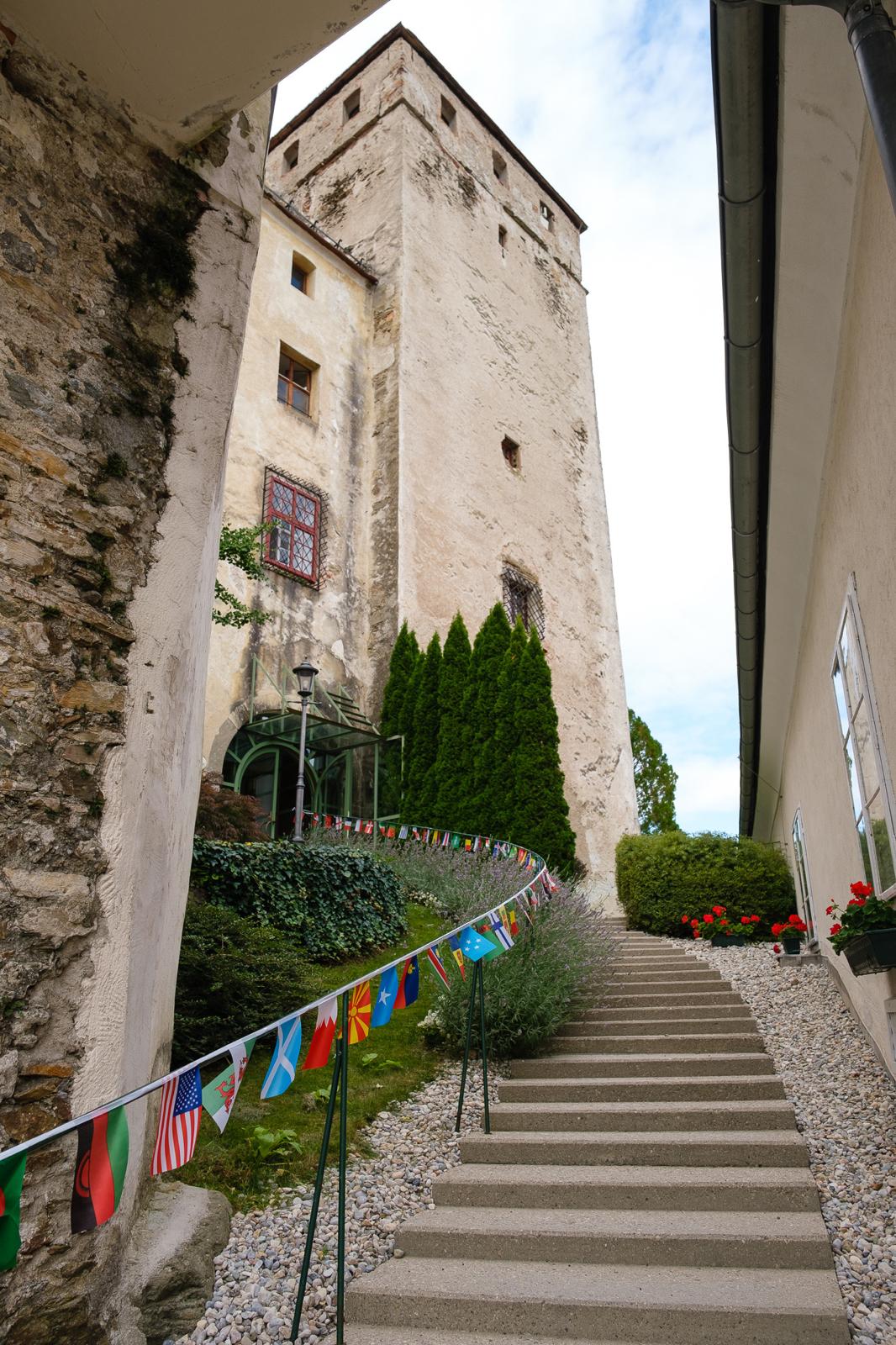
The 13th-century castle of Schloss Krumbach International School in Krumbach, Austria, where the school’s admissions team considers applications throughout the year.”

How Boarding School Waiting Lists Work — and How to Strengthen Your Position

This guide is for parents whose child is on a boarding school waiting list, or may be, including families applying from abroad. It covers how lists work, when places open, what helps, what a second place costs and when to move on, not the admissions timeline or reapplying.

What a boarding school waiting list means

A boarding school waiting list is the group of applicants a school would admit if a place opened after its first round of offers. A waiting-list decision is neither an offer nor a rejection.

Schools commonly make more offers than places because not every admitted family accepts, and the waiting list fills the gaps. Waiting lists differ: some are ranked, some are an unranked pool, and some cover one full grade. Places usually open after admitted families’ reply deadline, sometimes as late as August.

A family strengthens its position by confirming interest, sending one letter with new evidence of readiness and getting clear answers. A fallback place on known terms and a last date for using an offer protect the family. For a child who needs an Austrian residence permit, generally applied for in person abroad, the permit lead time sets the last useful offer date.

Key takeaways

Three ways schools run a boarding school waiting list

The model a school runs decides what your “position” on its list means. The third model belongs to rolling admissions, an admissions model in which applications can be considered throughout the year rather than only during one fixed application period.

ModelHow a place is offeredCan you learn your position?When it moves
Ranked listIn list orderOften, if sharedAfter the reply deadline
Unranked pool (wait pool)Chosen to fit the grade, such as a boarding bed or class balanceRarely; there is no orderAfter the reply deadline, sometimes into August
Grade-capacity list (rolling admissions)When a student in that grade leaves or capacity changesSometimesAny time; hard to predict

A ranked list tells you your place but not your chance. A pool gives no place at all, so fit with the grade matters more than when you applied.

Which model a school runs is the first thing to ask.

When a boarding school waitlist moves, and when you would know

Each year, many US independent boarding schools release decisions on 10 March and ask families to reply, with an enrolment contract, by 10 April. In a 2016 article by the Enrollment Management Association (EMA), which administers the SSAT, a former admissions dean called the two dates “a gentleman’s agreement”.

Places declined at the reply date go to families on the list, so most movement follows it. Without common dates, a second wave of offers follows each school’s own acceptance deadline. Schools’ published waiting-list policies often run into late summer, sometimes August.

So what can a family realistically know in April? No school can honestly give odds before the replies are in. What you can learn is the model and closing date. Tell your child the plan and that date, not a probability.

Waitlisted at boarding school? Seven questions to ask before you wait

The National Association of Independent Schools (NAIS) asks US member schools, in its admissions Principle 5, for “clear information, dates, and timeframes”, including “waitlist policies, and financial obligations”. That is a fair standard for any school.

  1. Is the list ranked or a pool, and will you share our position? Clear answer: the model, and yes or no.
  2. Has the list moved recently, and in which grades? Clear answer: a plain account, or “we cannot predict”.
  3. Until when does the list stay open, and does it carry over? Clear answer: a date.
  4. How would an offer reach us, and how long would we have to reply? Clear answer: the channel and a number of days.
  5. What would accepting commit us to, and what is refundable? Clear answer: written terms, and the total costs that NAIS Principle 6 asks member schools to share before an enrolment commitment.
  6. Would a new report or language result help, or nothing extra? Clear answer: yes or no, and the format.
  7. If an offer came too late for travel, could the place move to January or the next year? Clear answer: yes, no, or case by case.

How to get off a boarding school waitlist: five steps that help

One clear reply, one letter and new evidence help more than persistence.

  1. Reply promptly in writing that you want to stay on the list, and say until when.
  2. Send one letter of continued interest to the boarding school: short, ideally from the student, naming the school as first choice if true and saying what is new. Follow the school’s instructions first, as some want nothing extra.
  3. Send new evidence when it exists: a new school report, a higher language level or a completed course.
  4. Offer honest flexibility (a January start, where available, or another grade), but only where it makes academic sense. A late start tends to be easier in a lower grade than midway through a two-year course such as the IB Diploma Programme or Cambridge International A Level.
  5. When you accept a place elsewhere, tell the other schools at once so their lists can move.

Repeated emails, third-party pressure and offers of money beyond published fees do not help.

At SKIS, Availability Is Only One Part of the Admissions Decision

Schloss Krumbach International School accepts applications throughout the year, but an available place on its own does not determine admission.

SKIS looks at the student as a whole. Admissions considers previous academic performance, current subject knowledge, English level, German for Grades 7 to 9, motivation, willingness to learn, readiness for boarding and whether the student and family are comfortable with the structure and values of the school.

Applicants complete online oral assessments in English, Mathematics, History and Geography, and Sciences. German is also assessed for Grades 7 to 9. The purpose of these assessments is to understand the student’s current level, strengths and areas that may require support, rather than to reduce the decision to one entrance score.

Classes at SKIS have a maximum of 10 students, so capacity genuinely matters. At the same time, the school does not publish a ranked waiting-list system in its current Admissions materials. Families should therefore ask Admissions directly about availability in the relevant grade and what later entry options, if any, are realistic.

A language gap does not always mean that the application must wait for another year. The entry requirements and assessments indicate approximately B1 English as the general admissions profile. For Grades 7 to 9, A2 German is the general entry profile, while German is not required for admission from Grade 10. Accepted students who need more preparation can be offered an online intensive English or German programme before the academic year begins.

The student also needs to understand what they are applying to. SKIS is a structured full-boarding, phone-free school. Motivation, willingness to participate, respect for others and the student’s own attitude towards joining matter because the school is deciding not only whether the student can manage the academics, but whether the environment is likely to work well for them.

For International Families, the Residence Permit Can Set the Real Deadline

For a student who needs an Austrian Residence Permit – Pupil, a school place can become available too late to use for the intended start date.

Austria generally requires the first application to be submitted in person through the appropriate Austrian embassy or consulate abroad. The application is then forwarded to the competent residence authority in Austria. Austrian authorities must decide residence applications as soon as possible and no later than six months after receipt unless a shorter statutory period applies. The Pupil permit does not have the 90-day deadline that applies to the university Student permit.

For an end-of-August school start, our separate visa-planning guide uses mid-to-late January as a cautious planning date for filing a complete application. January is not an Austrian legal deadline. It simply avoids building the school-start plan around a decision arriving faster than the law requires.

This matters when deciding how long to remain on a waiting list. A place offered in spring or summer may still be usable if the residence process moves quickly, but a family should not assume that it will.

Ask three questions early:

  1. When could the school actually issue the enrolment documents required for the permit?
  2. How long is the current embassy appointment wait in our country?
  3. What is the latest date at which we are personally prepared to accept the uncertainty of waiting?

For EU, EEA and Swiss families, the pupil-permit timetable does not apply.

Date or constraintWhat the family needs to know
First school dayThe intended arrival and academic start date
School documentationWhen the school can issue the enrolment documents needed for the residence application
Embassy appointmentHow soon the family can actually file the application
Residence-permit timingAustrian authorities may take up to six months
Alternative-school deadlineWhen another school requires a signed contract and payment
Family decision dateThe latest date the family is willing to keep waiting given all of the above
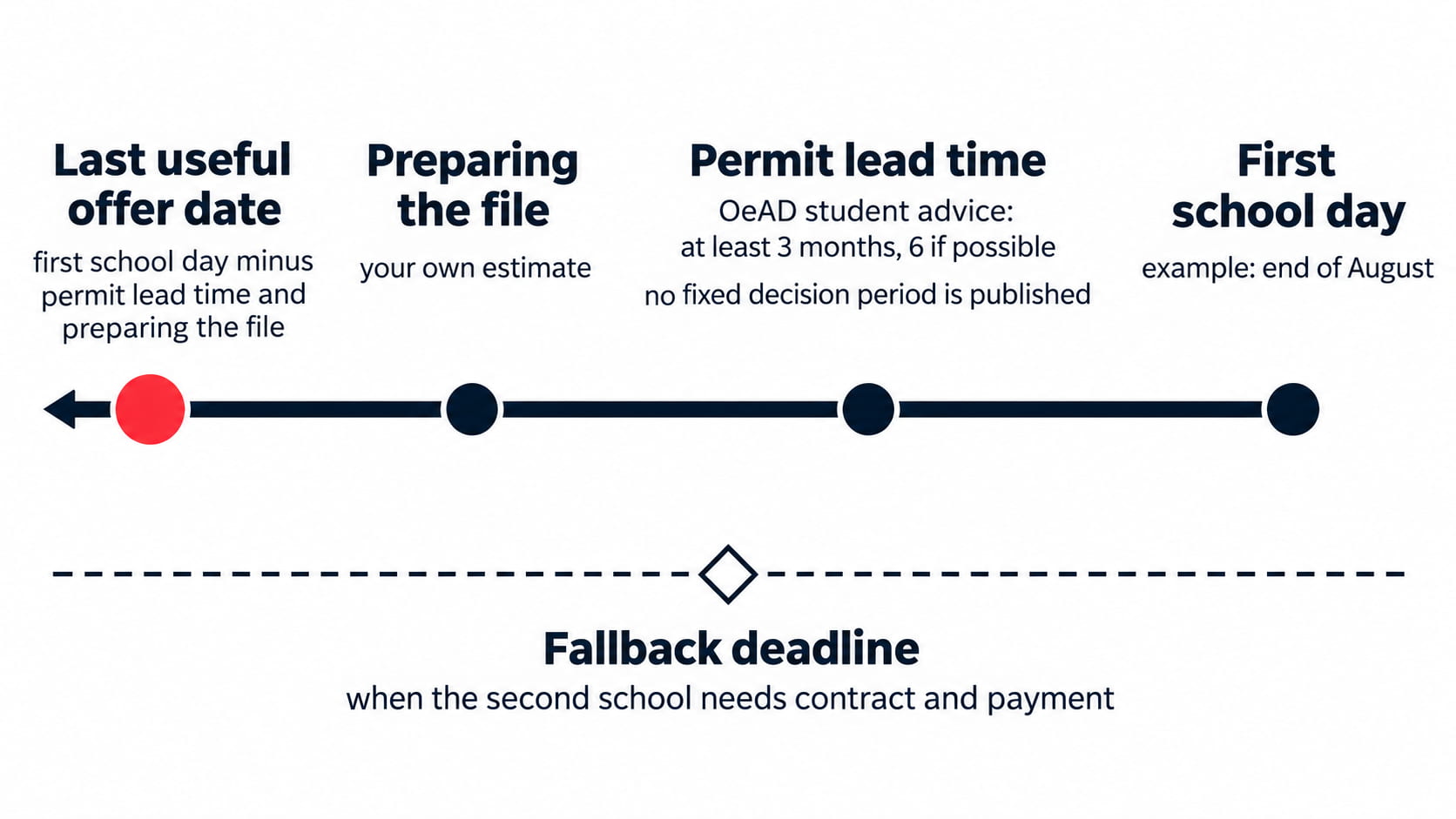
“Backwards timeline for working out a last useful offer date for a boarding school place in Austria: start from the first school day, for example the end of August, subtract the permit lead time (OeAD advises university students to apply at least 3 months before entry, 6 if possible, and Austria publishes no fixed decision period for the pupil permit), then subtract the time to prepare the file. The result is the last useful offer date. The fallback school’s deadline is tracked separately.
Our reading of published Austrian rules, not a legal rule.

The family decision date is practical, not legal. It will be different for every family.

Take an end-of-August start, as at SKIS. OeAD’s advice to students of at least three months means applying for the permit by the end of May (a planning floor, not a processing time). A usable offer must arrive earlier; question 7 above covers later ones.

This is our reading of published rules, not a legal rule: confirm your own lead time with the Austrian embassy or consulate, or an immigration adviser.


How Long Should You Stay on the Waiting List?

Holding a second school’s place means signing its terms and paying a deposit. A deposit is a refundable sum paid as part of enrolment and held according to the school’s contractual conditions. Signing usually binds you, so check refunds, notice terms and any non-refundable fee.

With two contracts for one child, the real price of staying on a list is what you would forfeit at the fallback school.

ChoiceChoose it whenCostNext step
StayClear answers; last useful offer date before any fallback deadlineTimeOne letter, new evidence, a diary date
HedgeVague answers, or the fallback deadline comes firstWhat the fallback keeps if you leaveAccept the fallback, stay listed, tell the first choice until when
Move onLast useful offer date passed, or your child is ready to commit elsewhereThis year’s first-choice placeWithdraw in writing; reapplying is a separate decision

Our view: if a school cannot tell you how its list works or until when it runs, hedge. That reflects what you can plan around, not the school’s quality.

A boarding school waiting list is neither an offer nor a rejection but a decision with a date on it. Write down your last useful offer date and forfeit figure, then put the seven questions to each school.

Families considering Schloss Krumbach International School can ask the admissions team about entry dates and assessments.

Frequently Asked Questions

Some boarding school waiting lists are ranked, many are unranked pools, and rolling-admissions schools often keep a list per full grade. Ask which model applies.

Many boarding school waiting lists run from admitted families' reply date until the school year starts, so places can open as late as August. At many US boarding schools that reply date is 10 April, a convention described in an Enrollment Management Association (EMA) article.

A letter of continued interest helps when it is a single short letter with new information, ideally from the student. Some schools want nothing extra, so read the waitlist instructions first.

Accepting another school's place while waiting is usually wise if the family can afford what it would forfeit. Read the refund and notice terms first, and tell other schools once you commit.

For a younger boarder, parents should look closely at the safety net around the child. Who notices when they are struggling? How structured are evenings and weekends? Can they contact home reliably? Who helps them learn the routines? How are older and younger students expected to treat one another?

At Schloss Krumbach International School, students can join from Grade 7, at around age 12. The school is deliberately small, with a maximum of 10 students per class, so teachers know students closely. Boarding staff see students throughout daily life, while older students help younger students and newcomers understand routines and expectations. Students also have structured study time, regular family contact and clear residential supervision.

A 2007 review of homesickness research published by the American Academy of Pediatrics found that previous time away from home predicted homesickness better than age did. Children given no say in the decision were also more likely to be homesick.

A summer offer often comes too late for a student who needs an Austrian residence permit. OeAD advises university students to allow at least three months, so ask whether a late place could start later.

We consider applications throughout the year, including possible mid-year entry. A later start depends on availability, the student’s previous academic programme and whether the timing allows a successful transition into the relevant grade. Families considering a later start should contact Admissions so we can assess the individual situation.

About the Author

Admissions at Schloss Krumbach International School in Krumbach, Austria. Her areas are the admissions process, placement tests, entry requirements, and visa support for international families. She wrote this guide to put the school year ahead of the birthday.

Explore
Drag
Schloss Krumbach International School
Privacy Overview

This website uses cookies so that we can provide you with the best user experience possible. Cookie information is stored in your browser and performs functions such as recognising you when you return to our website and helping our team to understand which sections of the website you find most interesting and useful.