Skip links
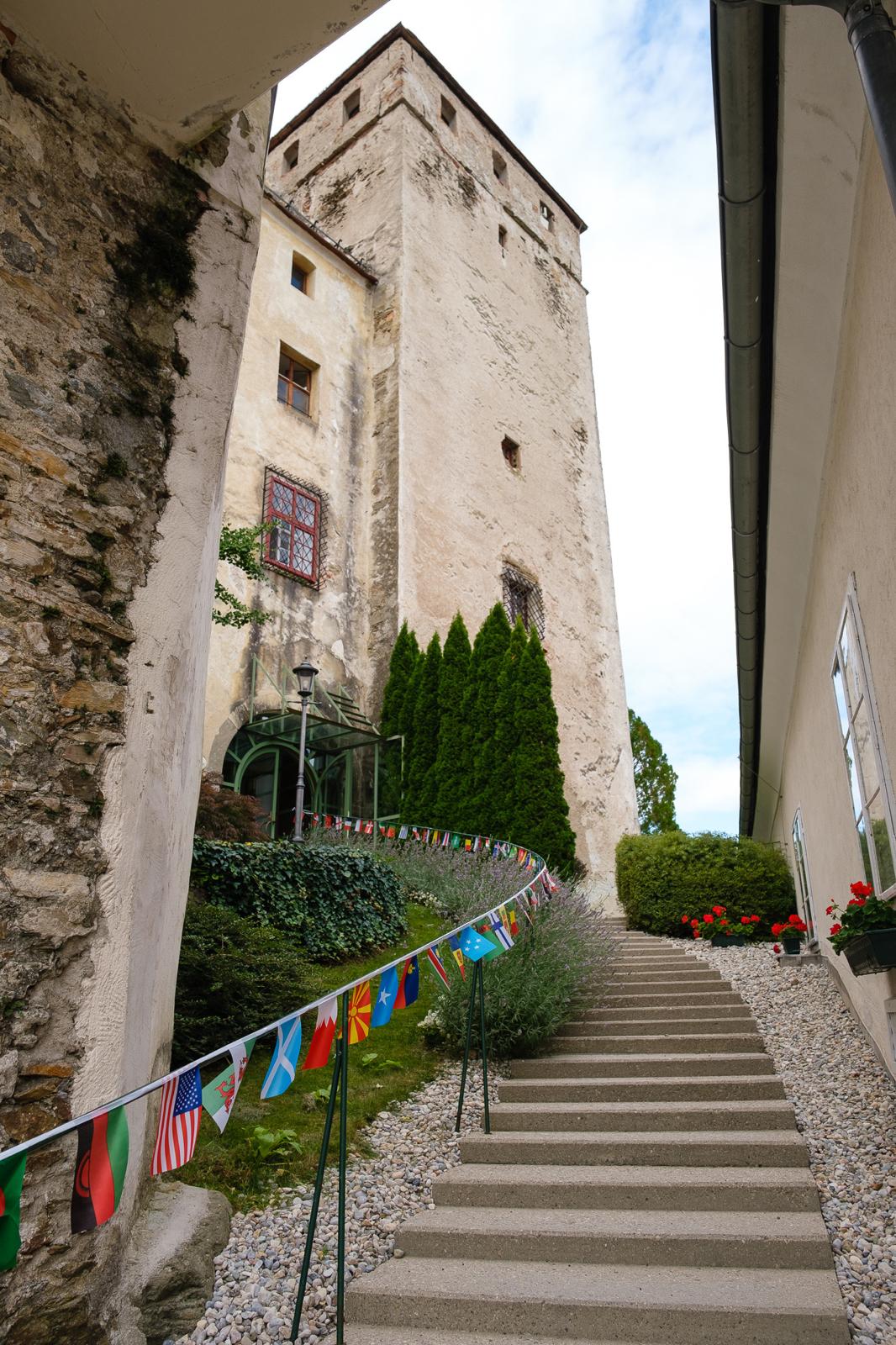
Schloss Krumbach International School, the 13th-century castle in Krumbach, Austria, where the school’s students study and board.

Reapplying to Boarding School: Turning a Setback into a Stronger Application

This guide is for parents working out what to do after a boarding school rejection, whether a plain no or a waitlist that ended without an offer. It covers what the decision means, when to reapply and how to use the year in between; college admissions and waitlist mechanics are outside it.

What to Do After a Boarding School Rejection: The Short Answer

What to do after a boarding school rejection comes down to one question: whether the reason was “not yet” or “not here”. A “not yet” is something a year can change: a language level, one weak subject, late timing or no place at that entry point. A “not here” is a mismatch with a school’s values, rules or way of life, which a year rarely changes.

Reapply after a “not yet” if the next application can show real change; choose another school after a “not here”. A boarding school’s no is a decision about one application at one school, not a verdict on the child.

Each boarding school sets its own reapplication rules, so the next chance may be months or a year away.

Key takeaways

Not Yet or Not Here: Why Boarding Schools Say No

This guide sorts the reasons a child is rejected from boarding school into six types. In the Setback Diagnostic, times follow a published guideline where one exists, and judgement otherwise.

ReasonHow it showsNot yet or not here?Time to change it
No place at that entry point, or late timingA waitlist with no offer; a late applicationNot yet; often the easiest fixNext round if the cycle is fixed; sooner with rolling admissions
Academic levelFeedback on one or two subjects; reports below the school’s barNot yet, if the gap is specificA school year of reports; at schools that use the ISEE entrance test, a later testing season
Language levelDifficulty in the school’s language at interview or assessmentNot yetApproximately 200 guided learning hours per CEFR level (Council of Europe scale), a guideline (Cambridge English)
Readiness for boardingDoubts about independence or routinesOften not yetA school year of growing responsibility
Fit with values and rulesReluctance about the school’s rules or approachUsually not hereA year rarely changes it
Application qualityAn incomplete file; an unprepared interviewNot yetWeeks

Reapply when the reason was “not yet”; choose another school when it was “not here”. When two reasons combine, the slower one sets the timetable. For some children, a “not here” is the right answer.
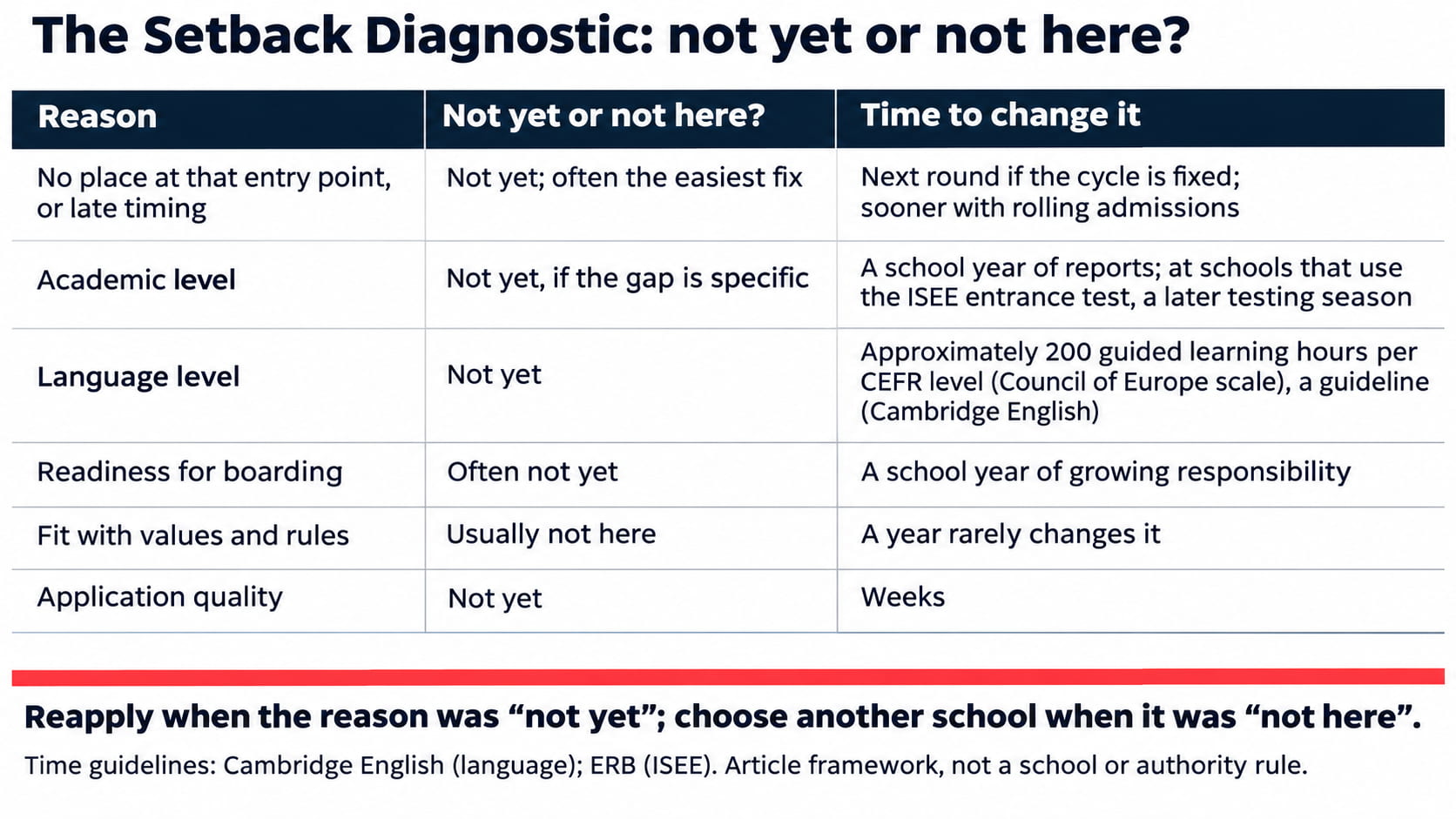
The Setback Diagnostic, a table of six reasons a boarding school may say no, each marked “not yet” or “not here” with the realistic time to change it, ending with the rule: reapply on a “not yet”, choose another school on a “not here”.
The Setback Diagnostic, a table of six reasons a boarding school may say no

Asking the School for Feedback After a Rejection

Some schools explain a boarding school rejection in detail; others give only a general reason. Ask once, by short email or call, after the decision season has settled.

  1. Which part decided it: assessments, interview, reports or the number of places?
  2. Was it a question of level, or of fit?
  3. Do you accept reapplications for this grade, and is there a minimum gap first?
  4. Would a new application start from scratch, or does the earlier file count?
  5. What would you need to see change?

Keep the request brief and focused on understanding the decision. Ask whether the school considers reapplication realistic and what, if anything, it would need to see change before reviewing the student again.

Can You Reapply to a Boarding School That Said No?

No authority publishes reapplication rules for boarding schools; admission.org, an admissions publisher, says reapplying is usually possible and the reason for the first no matters most.

After a boarding school rejection, the next chance depends on the school’s cycle. According to published admissions guides, many US boarding schools take applications by mid-January and release decisions together on 10 March. In the UK, boarding entry commonly happens at age 13 or 16 (13+ and 16+).

Rolling admissions is an admissions model in which applications can be considered throughout the year rather than only during one fixed application period.

At a school with a fixed annual admissions cycle, the next application may not be possible until the following year. Rolling admissions can offer more flexibility, but the school still decides whether and when another application makes sense.

How to Strengthen a Boarding School Application in a Year

Evidence of change gives an admissions team more to weigh than a better-written letter does.

The CEFR, the Council of Europe’s six-level language scale from A1 to C2, describes ability through “can-do” statements. Its B1 descriptor opens: “Can understand the main points of clear standard input on familiar matters regularly encountered in work, school, leisure, etc.”

Cambridge English puts the move up one CEFR level at approximately 200 guided learning hours — a guideline only. Guided learning hours mean classroom study with a teacher plus guided self-study, so expect regular lessons over many months.

Language requirements also work differently from school to school. A student who falls slightly below a school’s usual entry profile may not always need to wait a full year. Some schools offer pre-arrival preparation or make an individual decision based on the student’s overall application. Families should ask before assuming that a language gap automatically means rejection or a one-year delay.

The Independent School Entrance Exam (ISEE) is used mainly by US schools. ERB, the Educational Records Bureau, allows one ISEE sitting per testing season, up to three a school year.

The Enrollment Management Association owns the SSAT, another US admissions test, and reported in 2016 that retakers make “modest score gains” on average. A retest may move a score a little, but only a year of change answers a no about readiness, language or fit.

What to show next time, by reason:

  • Academic level: a year of reports showing progress in the weak subject
  • Language level: an assessed level, not a self-description
  • Readiness for boarding: responsibilities kept at home and school
  • Application quality: a complete file and interview answers in the child’s own words

A 12-Month Plan for Reapplying to Boarding School

The month windows are a suggestion; with rolling admissions, the steps can run faster.

  1. Weeks 1-2: ask for feedback and write down exactly what was said.
  2. Month 1: place the reason in the Setback Diagnostic and decide whether to reapply next year or choose another school. Does your child want to try again, or is the wish mainly yours?
  3. Months 2-9: work on what the reason requires: language lessons, the weak subject or responsibilities that show readiness for boarding. At an ISEE school, plan the retest around the testing seasons.
  4. Months 6-9: check the next round’s dates and ask which documents can be reused.
  5. Months 9-12: collect the latest reports, an assessed language level and a note on what changed; prepare your child to speak for themselves.
  6. International families, throughout: documents, translations and visa or residence-permit steps take time; check timing with the destination country’s embassy or consulate.
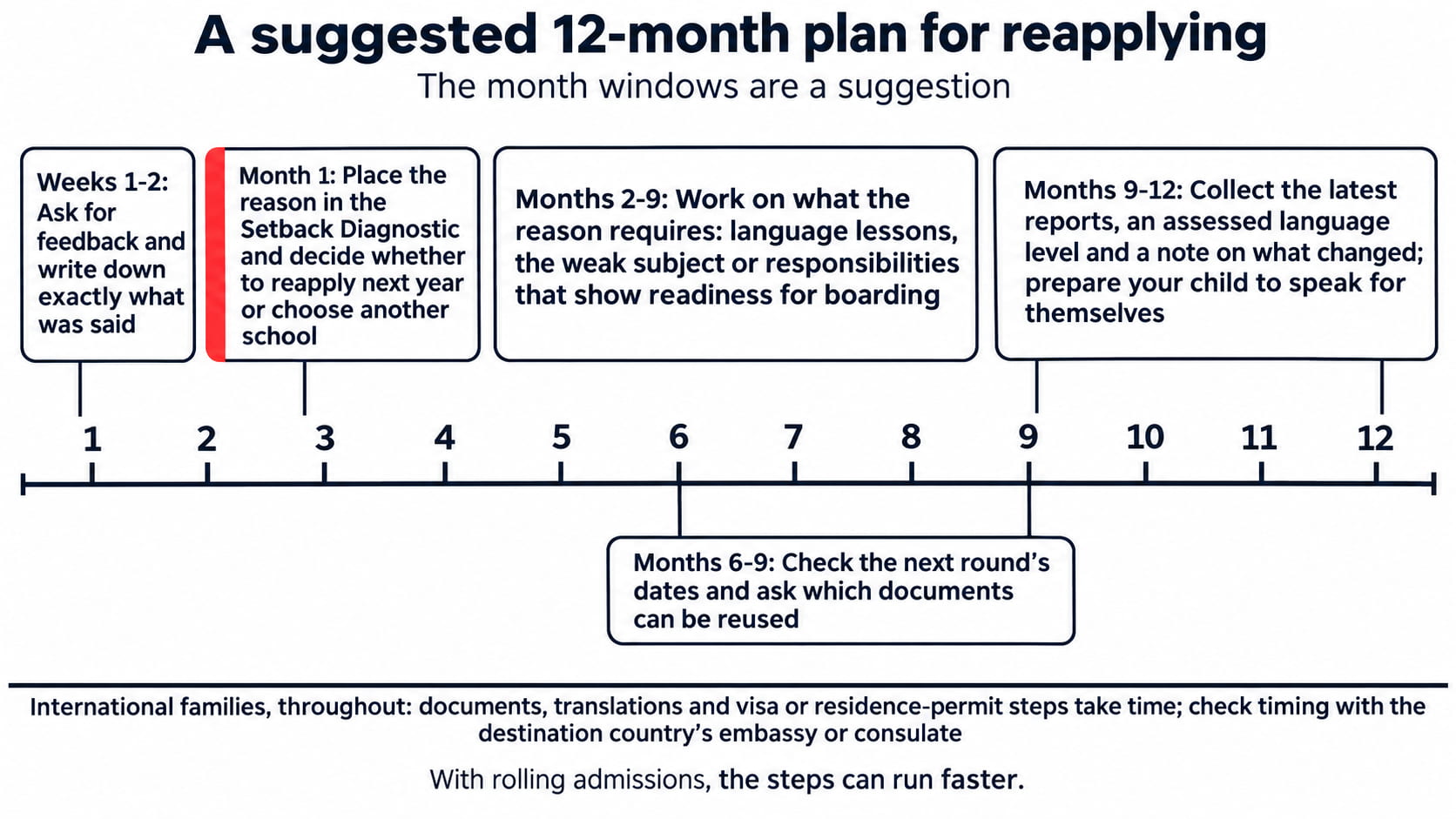
“A suggested 12-month reapplication plan: ask for feedback in weeks 1-2, decide in month 1, work on the reasons in months 2-9, check application dates in months 6-9, and gather new evidence in months 9-12. International families allow time for documents and visas throughout.
A suggested 12-month reapplication plan

What One Selective School Assesses: The Schloss Krumbach Example

The grounds and facade of the 13th-century castle that houses Schloss Krumbach International School, 90 km from Vienna.
The school’s campus is 90 km from Vienna, about an hour’s drive.

Admissions criteria differ widely, so what follows is one school’s process, not a sector standard. Schloss Krumbach International School, an international boarding school for Grades 7-12 in a 13th-century Austrian castle, 90 km from Vienna, accepts applications throughout the year for Grades 7 to 12 and reviews each student individually.

SKIS considers previous academic performance, subject knowledge, English level, German for Grades 7 to 9, motivation, willingness to learn, readiness for boarding and whether the student is comfortable with the structure and expectations of the school. The student is assessed as a whole rather than through one entrance score.

What SKIS considersHow it is assessed
Previous academic performanceRecent school reports and academic history
Subject knowledgeOnline oral assessments in English, Mathematics, History and Geography, and Sciences
EnglishApproximately B1 is the general admissions profile; English is assessed directly
German, Grades 7 to 9A2 is the general entry profile and German is assessed during Admissions
MotivationThe student discusses their interests, attitude to learning and reasons for joining
Boarding readinessAdmissions considers whether the student is ready for a structured full boarding environment
Personal fitThe student’s willingness to participate and alignment with the school’s structure, expectations and values are considered
Availability and timingLater entry depends on available places, previous schooling, current level and whether a successful transition is realistic

A language gap does not automatically mean that a student must wait another year. At SKIS, A2 German is the general entry profile for Grades 7 to 9, while German is not required for admission from Grade 10. Accepted students who need additional preparation can be offered an online intensive German or English programme before arrival.

Families should also understand the boarding model before applying. SKIS students do not use personal smartphones or social media during everyday school and boarding life, and AI services are not used for academic work. The school provides academic technology when it is needed. A student who does not want this type of structured, phone-free boarding environment, or the wider boarding policy, would reach a “not here” of its own and may be happier at a different school.

SKIS Admissions Looks at the Whole Student

At SKIS, the admissions process is designed to build a comprehensive picture of the student. Academic assessments are one part of that picture, but they are not the purpose of Admissions on their own.

We look at previous school performance, current subject knowledge, language level, motivation, willingness to learn, readiness for boarding and how the student responds to the structure and expectations of the school. We also want to understand the family, what they value in education and whether the student and family genuinely understand the kind of environment they are choosing.

The assessments are therefore not intended simply to eliminate students who do not arrive in perfect academic shape. They help us understand where a student is now, where support may be needed and whether SKIS is an environment in which that student is likely to develop well.

A student may have a gap in German, need more confidence in a particular subject or still be developing the independence required for boarding. These are different from a fundamental mismatch with the school. Where preparation can realistically address the gap, Admissions can explain what would need to improve and, where appropriate, what preparation may be possible before entry.

This matters particularly in a second application. We would not expect a student to return as a completely different person. We would want to understand what has changed since the first application and whether the original concern has been addressed.

That might mean stronger school reports, greater subject knowledge, a better language level or more evidence that the student can manage responsibility and boarding life. But it can also be a more mature understanding of why the student wants to join SKIS and what living within its rules and community actually involves.

Values matter as well. SKIS is a highly structured, full boarding, phone free environment. Students are expected to work seriously, respect others, take responsibility, participate in the life of the school and gradually contribute more to the community. A family does not need to present a perfectly polished child. It does need to feel comfortable with what the school is trying to develop and support those expectations at home.

For this reason, a first application can itself be useful. Even when it does not immediately lead to an offer, it can show the family and the school where the student stands academically, linguistically and personally, and whether there is a realistic path towards joining later.

A second application should therefore show progress, but also greater clarity: the student understands the school better, the school understands the student better, and both sides have more evidence to decide whether the fit is right.

Reapply or Redirect After a Boarding School Rejection: The Decision

Would one more year change the reason, or only the date?

Reapplying may make sense when…Another school may make more sense when…
The original concern was specific and can be improvedThe school’s rules or environment do not suit the student
The school confirms that it accepts another applicationThe relevant entry point is no longer realistic
You can show concrete new evidenceVery little would be different in a second application
Your child genuinely wants to try againYour child no longer wants the school
The school still appears to be a strong fitAnother school now fits the student’s needs better

Choosing another school is a legitimate outcome. Our view: reshaping a child to fit one school’s rules is rarely a year well spent. Closing a language gap usually is. The one caveat is that only the school can say which kind of no it gave.

After a boarding school rejection, start with the reason the school gave, then decide with your child whether to reapply or choose another school. Questions about Schloss Krumbach International School’s admissions process go to its Admissions Team at info@krumbach.school.

Frequently Asked Questions

It can be, when the first decision identified something specific that can genuinely change. Examples include stronger academic performance, improved language skills, greater boarding readiness or a better timed application. Before applying again, ask the school whether it accepts reapplications and whether the change you are working on would materially affect its decision.

No published data shows how boarding schools treat reapplicants. Schools handle earlier applications differently, so ask the school itself.

At a fixed-cycle school, the next realistic chance is usually the following year's round; at a rolling-admissions school, it comes once the reason has changed. For a language gap, Cambridge English gives a guideline of approximately 200 guided learning hours per CEFR level.

In England, the Department for Education’s statutory School Admission Appeals Code, in force since 1 October 2022, covers local-authority-maintained schools, academies and free schools. Private schools set their own processes, so a private boarding school’s decision is often final for that round.

A waitlist is neither an offer nor a refusal: it lists applicants a school may offer a place to if an admitted family declines. A waitlist that ends without an offer can reflect a shortage of places rather than a weak application.

SKIS considers previous academic performance, subject knowledge, English level, German for Grades 7 to 9, motivation, willingness to learn, personal readiness for boarding and alignment with the structure and values of the school. Applicants complete academic and language assessments and speak with the school. Admissions considers the student as a whole rather than relying on one entrance score.

About the Author

Admissions at Schloss Krumbach International School in Krumbach, Austria. Her areas are the admissions process, placement tests, entry requirements, and visa support for international families. She wrote this guide to put the school year ahead of the birthday.

Explore
Drag
Schloss Krumbach International School
Privacy Overview

This website uses cookies so that we can provide you with the best user experience possible. Cookie information is stored in your browser and performs functions such as recognising you when you return to our website and helping our team to understand which sections of the website you find most interesting and useful.