Personal Statement
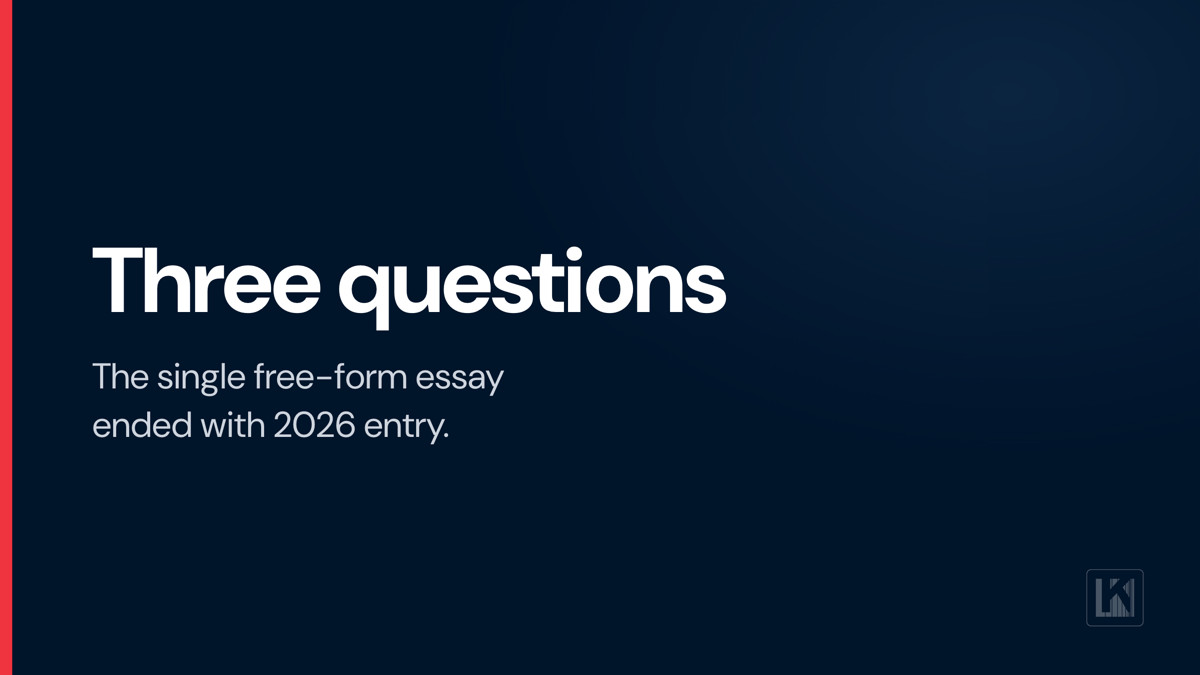
Personal Statement The personal statement is the part of a UCAS application written by the student. From 2026 entry it is no longer a single free-form essay: UCAS replaced it with three structured questions, answered in separate boxes but read together by admissions staff as one piece.
Key facts
| What | Detail |
|---|---|
| Changed for | 2026 entry onwards |
| Question 1 | Why do you want to study this course or subject? |
| Question 2 | How have your qualifications and studies prepared you? |
| Question 3 | What have you done outside education that is relevant? |
| All required | Every question must be answered |
| Total length | 4,000 characters across all three, as before |
| Minimum | 350 characters per question |
What the change was for
UCAS framed the reform as levelling the field. A single blank box rewarded students who had been coached and who knew what the genre expected; direct questions tell everyone what is being asked, which helps applicants without that support most.
The total length did not change — 4,000 characters, now distributed across three answers rather than one essay. Students choose the split, subject to a 350-character minimum per question.
What it means in practice
The second question is where the academic case is made, and it is the one that rewards specifics: not that a student enjoys chemistry, but what they did in a Higher Level investigation or an extended essay and what it taught them.
The third question has a wider definition of relevant than families expect. Work experience counts, but so do caring responsibilities, part-time jobs and sustained hobbies. For some courses it carries more weight than for others.
Because admissions staff read the three answers as one, repetition is the main avoidable mistake — the same anecdote in two boxes wastes characters. The official wording and current limits are published by UCAS.
At Schloss Krumbach
The raw material for question two is coursework a student has already done. An extended essay, a Higher Level internal assessment or an A Level project gives something concrete to write about, which is worth remembering when those topics are chosen in Grade 11 rather than when the application is drafted in Grade 12.
How Schloss Krumbach supports the writing itself is not described on the school site. Ask Admissions who works with students on applications and at what point in the year it starts.
Frequently asked questions
Is the personal statement still one essay?
No. From 2026 entry it is three structured questions answered separately, though admissions staff read them together as a single statement.
How long should each answer be?
There is a 4,000-character total across all three and a 350-character minimum for each. Within that the student decides the balance.
Does every university see the same statement?
Yes. One statement goes to all five UCAS choices, so it cannot be tailored to a single university.
Free PDF guide
IGCSE, IB or A Levels: which route fits your child?
The routes from Grade 9 to university side by side: what each qualification involves, how universities read it, and the questions to ask any school.
The PDF opens right after you submit.