Six Subject Groups
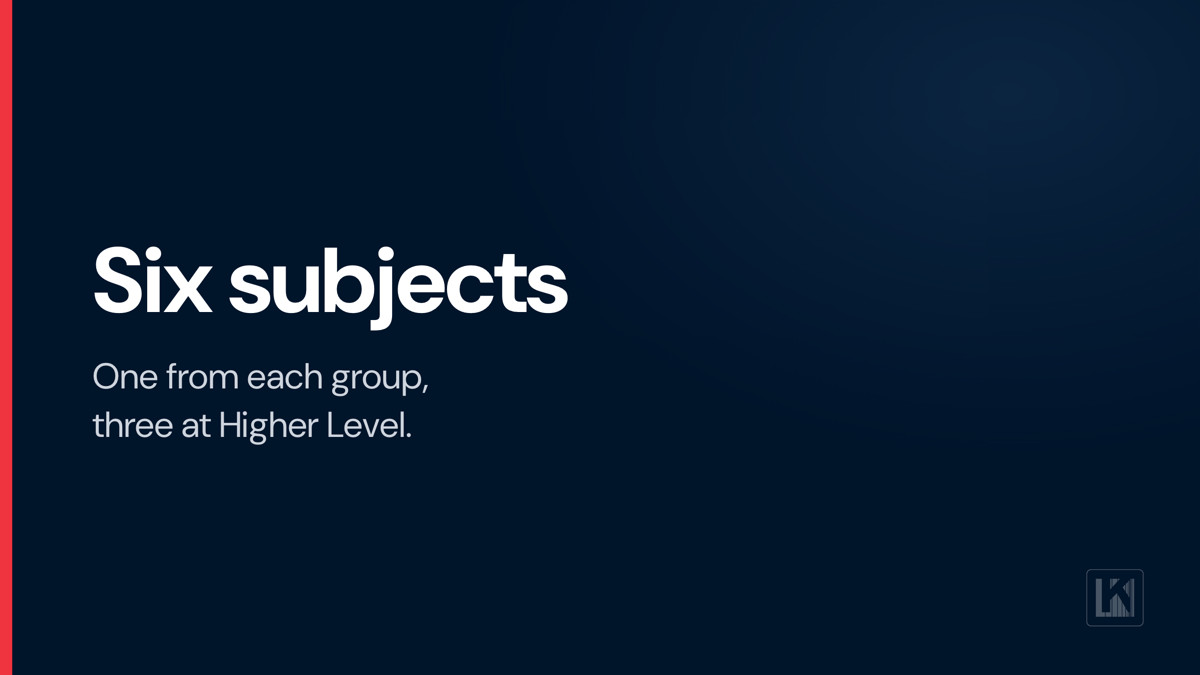
Six Subject Groups The six subject groups are the structure of the IB Diploma. A student takes one subject from each: language and literature, language acquisition, individuals and societies, sciences, mathematics, and the arts — with the sixth optionally replaced by a second subject from another group. Three are taken at Higher Level and three at Standard Level.
Key facts
| What | Detail |
|---|---|
| Group 1 | Studies in language and literature — the student’s strongest language |
| Group 2 | Language acquisition — a second language |
| Group 3 | Individuals and societies — history, economics, geography and others |
| Group 4 | Sciences — biology, chemistry, physics and others |
| Group 5 | Mathematics — two routes, Analysis or Applications |
| Group 6 | The arts, or a second subject from groups 1 to 5 |
| Levels | Three subjects at Higher Level, three at Standard Level |
Breadth is the point
The structure is deliberately inflexible. A student cannot drop mathematics to take three sciences, or abandon languages to concentrate on the humanities. Everyone leaves with a language, a science, mathematics and a social science.
This is the main structural difference from A Levels, where a student typically takes three subjects and specialises early. Neither is better in general: the IB suits a student who is undecided or genuinely broad, A Levels suit one who already knows and wants depth.
Higher Level is the decision that matters
Three subjects are taken at Higher Level, with roughly 240 teaching hours each against 150 at Standard Level. Universities read those three closely — they are where subject-specific entry requirements usually land.
A student intending to read engineering needs mathematics and physics at Higher Level; medicine normally needs chemistry and biology. Getting this wrong in Grade 11 is expensive, because changing level mid-course is not always possible and an offer may be conditional on a Higher Level grade.
The six subjects sit alongside the Diploma core: the extended essay, Theory of Knowledge and CAS. Full requirements are published by the International Baccalaureate.
At Schloss Krumbach
At Schloss Krumbach the Diploma runs in Grades 11–12 with three subjects at Higher Level and three at Standard. Group 1 offers English, German or a mother tongue; Group 2 English or German, including German ab initio; Group 3 History of Europe or Environmental Systems and Societies; Group 4 biology, chemistry, physics or ESS; Group 5 Mathematics Applications and Interpretation or Analysis and Approaches; Group 6 Visual Arts, or a second subject from the earlier groups.
The core is the standard one: a 4,000-word extended essay, Theory of Knowledge and CAS. Subject availability is set each year — confirm the current list with Admissions. See also IB at Schloss Krumbach.
Frequently asked questions
Can my child skip the arts?
Yes. Group 6 may be replaced with a second subject from groups 1 to 5, which is what most students intending to read sciences do.
How are Higher and Standard Level different?
Higher Level subjects carry roughly 240 teaching hours against 150 at Standard, and go further in both content and assessment. Universities set subject requirements at Higher Level.
When are subjects chosen?
At the start of the Diploma, in Grade 11. At Schloss Krumbach the Pre-Diploma year in Grade 10 exists partly to make that choice an informed one.
Free PDF guide
IGCSE, IB or A Levels: which route fits your child?
The routes from Grade 9 to university side by side: what each qualification involves, how universities read it, and the questions to ask any school.
The PDF opens right after you submit.