What Age Is Best to Start Boarding School?
Updated: October 2026
Ask “what age can a child go to boarding school?” and most answers stop at “it depends on the child”. This guide uses UK school census data and research on homesickness to turn that into a decision about timing. It is for parents of a child aged about 10 to 16, and does not compare boarding with day school or cover settling in.
What Age Can a Child Go to Boarding School? The Short Answer
Some UK boarding schools take children from age 7, but few start that young. Ages 7 to 10 made up 3.5% of new boarders at UK Independent Schools Council (ISC) schools in 2025-26.
Age 16 is the largest entry point at UK ISC schools: 34.7% of new boarders in 2025-26 (ISC Census 2026). It is the start of sixth form, the last two years of UK secondary school. Age 13, the start of senior school, is the second-largest UK ISC entry point, at 28.5% of new boarders in 2025-26.
Research does not point to a single best age to start boarding school.
The best time to start boarding is the beginning of a new school stage, for a child who has spent time away from home and wants to go. Joining partway through a two-year exam course, at 15 or 17 in the UK system, means catching up with a class that has already started.
A 2007 review of homesickness research, published by the American Academy of Pediatrics, found that previous time away from home predicts homesickness better than age does. Thurber and Walton’s 2007 review also found that children with no say in the decision to go are more likely to be homesick.
Key takeaways
- Most new boarders at UK ISC schools start at 16 or 13, as a new stage begins.
- Join at the start of a stage, not at a birthday.
- Previous time away from home and a say in the decision matter more than age.
- A mid-course start means joining a class that has already begun.
- Check how a school looks after your child’s age group.
Jump to: When most start · The stage-start rule · Readiness · What research says · Questions for a school · One school’s answer · Decision table · FAQ
When Most Children Start Boarding School: The UK Census Data
In its Census and Annual Report 2026, the Independent Schools Council (ISC) counted 16,719 new boarders at its UK member schools in 2025-26. Two ages, 16 and 13, made up 63.2%, almost two in three.
| Age at entry (UK year group) | Share of new boarders, 2025-26 | Where it falls in UK schooling |
|---|---|---|
| 7–10 (Years 3–6) | 3.5% | Junior and prep-school years |
| 11 (Year 7) | 8.0% | Start of secondary school |
| 12 (Year 8) | 3.3% | Mid-stage: last prep-school year |
| 13 (Year 9) | 28.5% | Start of senior school (13+ entry) |
| 14 (Year 10) | 11.3% | Start of two-year GCSE and IGCSE courses |
| 15 (Year 11) | 7.4% | Mid-course: second GCSE/IGCSE year |
| 16 (Year 12) | 34.7% | Start of sixth form: A Level or IB Diploma Programme |
| 17 (Year 13) | 3.3% | Mid-course: final sixth-form year |
ISC Census and Annual Report 2026, Table A.5 (UK ISC member schools; census day 15 January 2026). Shares calculated by us from 16,719 new boarders. Ages are the usual age at the start of the UK school year.
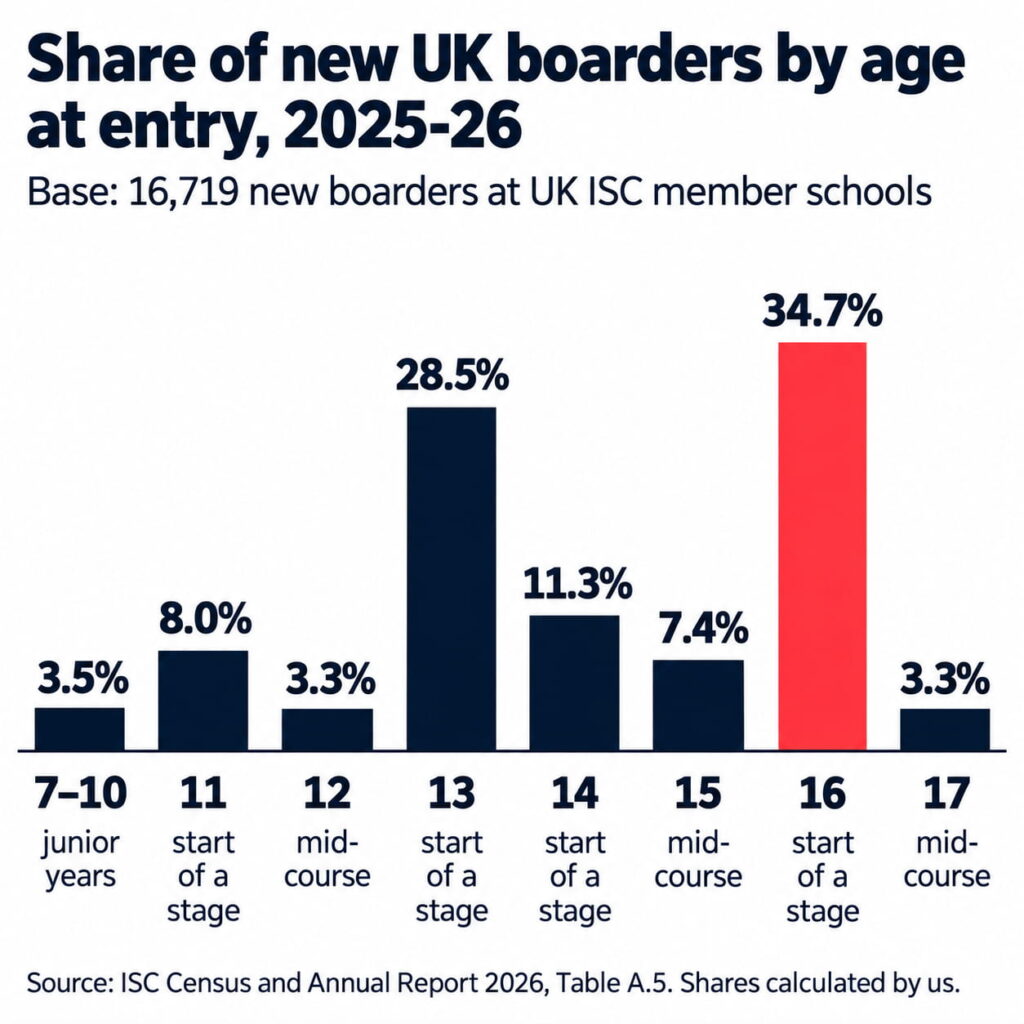
Ages 11, 13, 14 and 16 open a stage; 12, 15 and 17 fall in the middle of one. By our count, about four in five new boarders at UK ISC schools in 2025-26 (82.5%) started at the beginning of a stage. About one in seven (14.0%) joined part-way through one.
The junior years, ages 7 to 10, account for the remaining 3.5% in 2025-26.
One year separates the biggest entry point at UK ISC schools from one of the smallest. In 2025-26, 34.7% of new boarders started at 16, and 3.3% at 17.
In 2025-26, more than half of junior ISC boarders were flexi boarders, who stay some nights a week rather than every night. In the same year, 86% of sixth-form boarders were full boarders. Full boarding is a residential educational model in which students live at school and follow a structured academic and boarding programme.
The data covers UK ISC member schools only, from one census taken on 15 January 2026. “New” means new to that school (a pupil counted here may have boarded somewhere else first). UK year labels run one ahead of international grade numbers, so compare by age: UK Year 9 is roughly Grade 8.
The Stage-Start Rule: Why Boarding School Age Clusters at 13 and 16
The census peaks at 13 and 16 sit where something new begins. In the UK, many prep schools, the private schools that prepare children for senior school, end at Year 8. Senior schools therefore take a large intake at 13. Sixth form starts at 16.
Exam courses set the dates too. Cambridge International designs the Cambridge IGCSE as a two-year course for 14 to 16 year olds. It covers the same window as the GCSE, the main UK exam taken at 16.
The International Baccalaureate describes its IB Diploma Programme as a two-year programme for students aged 16 to 19. Cambridge International A Levels, which are subject-by-subject exams, cover the same ages and, according to Cambridge International, typically take two years.
A child who starts at the beginning of a two-year course starts with everyone else. A child who joins at 15 or 17 arrives for the second year — after the class has formed and assessed work has begun.
Join at the start of a stage, not at a birthday.
That is the stage-start rule. The UK pattern of boarding school age does not travel, but the rule does. Stage boundaries differ between countries and between schools, so ask any school on your shortlist where its stages begin.
Readiness: Experience and Choice Matter More Than Age
A child’s age is a rough stand-in for experience, and experience is the stronger signal. The source is Thurber and Walton’s clinical report Preventing and Treating Homesickness, published by the American Academy of Pediatrics in Pediatrics in 2007.
The American Academy of Pediatrics retired the report in 2017. The report’s experience findings come from studies of children at summer camps and boarding schools.
Little previous time away from home is among the strongest predictors of homesickness. In the report’s example, an 8-year-old with plenty of time away is less likely to be homesick than a 12-year-old with very little. The strongest family factor is what the report calls low “decision control”. A child forced to go is more likely to be homesick than a child who shared the choice.
Together, experience and choice make a two-question readiness test. Has your child spent several nights away from home without you, and is boarding their decision as well as yours?
If either answer is no, the authors advise practising time away first, such as two or three days with a relative or a friend. Give your child real choices about boarding, even small ones. Do not promise to bring them home if they do not like it: the authors warn against this “pick-up deal”.
What Research Says About Starting Younger or Older
A 2024 meta-analysis by Zhong, Feng and Xu in Frontiers in Psychology pooled 49 studies. Most were published in Chinese, and many were on rural boarding schools.
Overall, boarding made almost no difference to student development. It was linked to stronger cognitive development and slightly weaker emotional and attitude-related outcomes.
By stage, primary-school boarders barely differed from non-boarders. The most negative result came in junior middle school, the lower-secondary years, and the authors link it to developmental timing. Senior high school, the upper-secondary years, was less negative.
Younger did not simply mean worse. Setting mattered as well as stage: urban boarding came out positive and rural boarding negative.
The review is not a study of fee-paying international boarding in Europe. The practical question is what a specific school does for children of your child’s age.
Questions to Ask a School About Your Child’s Age Group
A school that does not take your child’s age at the stage you need is the wrong school, however good it is. Schools also differ in how they look after each age.
- Do you take my child’s age and grade, and where do your academic stages begin?
- How many boarders are my child’s age, and who will they live alongside?
- Who is responsible for students overnight, particularly where the youngest boarders live?
- How does pastoral care differ for a 12 year old compared with a 17 year old?
- How do you support a younger or first time boarder during the first weeks away from home?
- What fills the youngest boarders’ evenings and weekends, how much genuine free time do they have, and how are they supervised on trips?
- How do staff notice and respond if a student becomes homesick, withdrawn or academically overwhelmed?
- What is the phone policy, and how can students stay in regular contact with their families?
- Which CEFR level in English, and in any second language, does this entry point require? What language preparation is available if the student is not there yet? CEFR is the Council of Europe’s Common European Framework of Reference for Languages. Its levels, such as A2 or B1, describe what a learner can do in listening, reading, speaking and writing, not a single test score.
Ask for the answers in writing, and ask to see a published policy on boarding supervision and pastoral care.
One School’s Published Answer: Schloss Krumbach International School
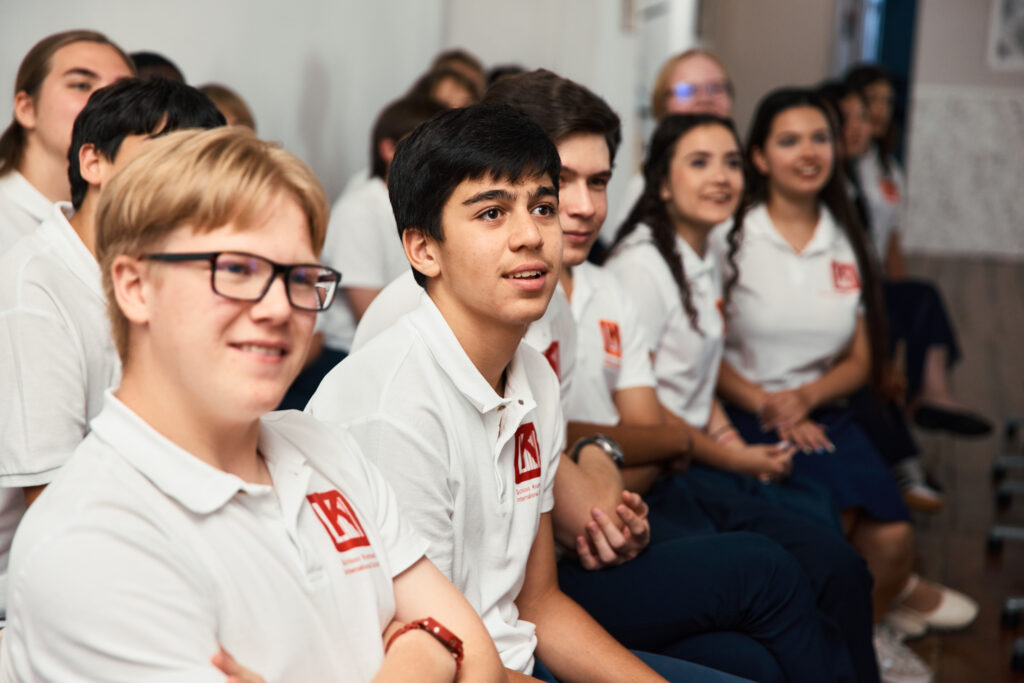
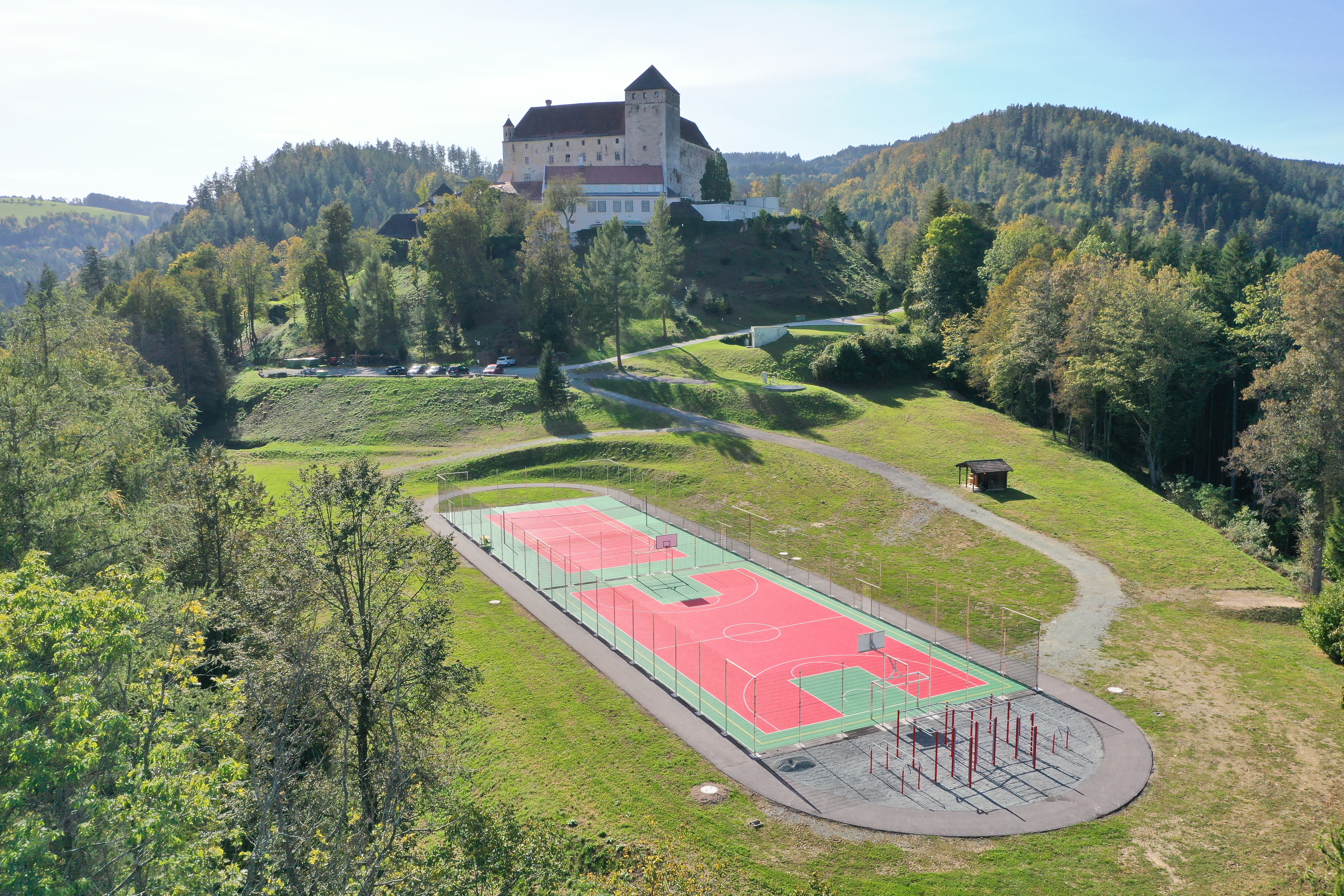
At Schloss Krumbach International School (SKIS), we have no junior boarding: our youngest students join Grade 7, at around age 12. A family weighing boarding at 8 to 10 is looking at a different kind of school. The table below answers two of the questions above: which grades the school takes, and which language level each entry point needs.
| Entry at | What the student joins | Language level required at entry |
|---|---|---|
| Grade 7, around age 12 | Bilingual Middle School, Grades 7 to 9 | English approximately B1 · German usually A2, with preparation available |
| Grade 8 or Grade 9 | Bilingual Middle School, joining the existing Grades 7 to 9 stage | English approximately B1 · German usually A2, with preparation available |
| Grade 10 | Pre Diploma. English becomes the language of academic instruction | English approximately B1 · no German required |
| Grade 11 | IB Diploma Programme or Cambridge International A Levels, Grades 11 to 12 | English at least B1 · no German required |
Students are accepted in Grades 7–12; the rows show where a new stage begins.
Grade 10 is the Pre-Diploma Grade, a preparatory academic year designed to develop the subject knowledge and study skills required before advanced diploma study. The end of Grade 10 is the decision point for the diploma route.
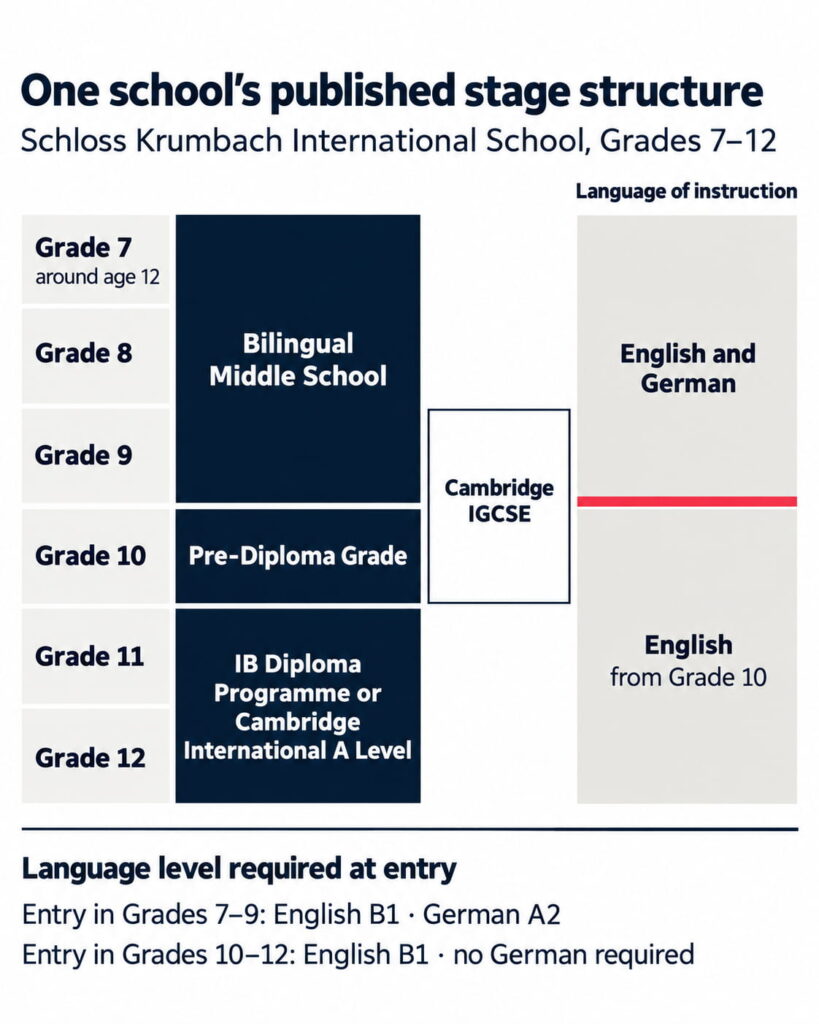
The entry requirements by grade at Schloss Krumbach contain a real trade-off.
A student joining in Grades 7 to 9 enters the bilingual Middle School, so German becomes part of academic life from the beginning. A2 is our usual entry profile, but it is not a rigid cut off. Students with little or no German can still be considered, and accepted students who need additional preparation are offered an intensive online German course before the school year begins, followed by continued language support at SKIS.
The advantage of starting earlier is that the student has more time to build German naturally before the diploma years. By Grade 10, the academic programme is taught in English, so German is not required for admission, although students continue studying it. Grade 11 then marks the beginning of the two year IB Diploma Programme or Cambridge International A Levels.
By graduation, most SKIS students reach a level of German strong enough to pass a C1 examination. SKIS is also a licensed ÖSD Examination Centre, Austrian Certificate for German Language, so students can take an internationally recognised German language examination directly through the school. This is particularly valuable for students considering German taught university programmes in Austria or elsewhere in the German speaking world, as according to Austrian university admissions guidance, German-taught degrees require CEFR B2 or C1, depending on the university and programme.

At SKIS, older students support younger students and newcomers as they learn the school’s routines and expectations. Boys and girls live in separate residential areas. Boarding staff provide supervision, and CCTV forms part of the school’s wider safeguarding and campus safety system.
For younger students, the support system extends across the whole day. Teachers and boarding staff see students in lessons, supervised study, meals, activities and evening routines, making it easier to notice when behaviour, confidence or academic progress changes. Students who need help can receive additional explanation, supervised revision, closer monitoring or simply a conversation with an adult who knows them.
SKIS is full boarding only, with no day, weekly or flexi option. There is no part-time way into boarding life for students from Grade 7 to Grade 12, so the readiness test above matters more.
The boarding week is deliberately structured around lessons, supervised academic preparation, meals, sport and outdoor time, reading, free time and evening routines. Supervised homework is built into the school day, and weekends combine academic preparation and Reading Club with sport, activities and genuine free time. The aim is to give students structure without organising every minute of their lives.
Phone free does not mean cut off from family. Students have unlimited IP telephone calls at no additional charge and two scheduled opportunities for Zoom calls with their families each week. Parents can also contact the Boarding Team when necessary.
Admission depends on academic readiness, language level, personal motivation and alignment with the school’s values, not on age alone, because students influence one another’s attitudes towards study, behaviour and everyday life. Older students are expected to support younger students and newcomers, and academic effort, reading and preparing properly are intended to feel normal within the community. Who the child lives with matters as much as the timetable.
Applications are accepted year-round.
Best Age to Start Boarding School: A Decision Table
What a child would join is a better guide than their age.
| Age (UK pattern) | What your child would join | What you are really deciding | Ask the school |
|---|---|---|---|
| 7–10 | Junior boarding, often only some nights a week | Whether a young child lives away from home at all | How many boarders are this age, and who is with them at night? |
| 11–12 | The first years of secondary school, or the last years of prep school | Who your child grows up among for the next several years | How are the youngest housed, and how do older students treat them? |
| 13–14 | Senior school, or the first year of a two-year exam course | A school community and a first external exam course | Will my child start the exam course at the beginning? |
| 16 | A two-year sixth-form course: IB Diploma Programme or A Levels | A university route, chosen through subjects | How are subjects and the route chosen, and with whose advice? |
| 15 or 17 | The middle of a two-year course | Whether a mid-course move is worth the catch-up | What has the class already covered, and is the next stage start a better date? |
So what age can a child go to boarding school? Choose the school year before the age.
Our view: start when a stage begins, with a child who has spent nights away and wants to board. The caveat matters — good timing does not rescue a child who never chose it.
Find your child’s row, then put its question to every school on your shortlist.
Frequently Asked Questions
What is the minimum age for boarding school?
In 2025-26, 3.5% of new boarders at UK Independent Schools Council schools were aged 7 to 10, and none were younger. Each school sets its own minimum age. According to GOV.UK, the UK Child Student visa covers ages 4 to 17; families should confirm visa rules with an immigration adviser.
What age do most children start boarding school?
At UK Independent Schools Council (ISC) schools, most new boarders start at 16 or 13. In 2025-26, 34.7% of new boarders at ISC schools started at 16, the start of sixth form, and 28.5% at 13, the start of senior school.
Is 16 too late to start boarding school?
No. Age 16 is the largest boarding entry point at UK Independent Schools Council schools. The two-year IB Diploma Programme and A Level courses begin at 16. Joining at 17, mid-course, is far rarer: 3.3% of new boarders at those schools in 2025-26.
Is 12 too young for boarding school?
Age alone does not decide whether a 12 year old is ready to board. Previous experience away from home, the child having a say in the decision, and the support system they are joining all matter.
For a younger boarder, parents should look closely at the safety net around the child. Who notices when they are struggling? How structured are evenings and weekends? Can they contact home reliably? Who helps them learn the routines? How are older and younger students expected to treat one another?
At Schloss Krumbach International School, students can join from Grade 7, at around age 12. The school is deliberately small, with a maximum of 10 students per class, so teachers know students closely. Boarding staff see students throughout daily life, while older students help younger students and newcomers understand routines and expectations. Students also have structured study time, regular family contact and clear residential supervision.
A 2007 review of homesickness research published by the American Academy of Pediatrics found that previous time away from home predicted homesickness better than age did. Children given no say in the decision were also more likely to be homesick.
Is there an advantage to starting boarding school earlier?
There can be, if the child is ready and the school is structured for their age. Starting at the beginning of an earlier academic stage gives a student more time to become part of the community, develop study habits and languages gradually, and learn how boarding life works before the pressure of the final diploma years.
At Schloss Krumbach International School, a student entering Grade 7 has three years in the bilingual Middle School before Grade 10 Pre Diploma and the final IB or Cambridge pathway. Younger students therefore have time to develop German, academic routines, friendships and independence gradually.
But earlier is not automatically better. A child who does not want to board or has very little experience away from home may benefit from more preparation first.
Those are the only additions I would make. The rest of the research article can remain as it is.
What ages and grades does Schloss Krumbach International School accept?
We welcome students in Grades 7–12, generally from around age 12 until the end of secondary school. Grades 7–9 form our bilingual Middle School, Grade 10 is the Pre-Diploma year, and Grades 11–12 are the diploma years. Final placement depends on age, previous schooling, academic background and admissions assessment.
Can a student start at Schloss Krumbach International School after the academic year has begun?
We consider applications throughout the year, including possible mid-year entry. A later start depends on availability, the student’s previous academic programme and whether the timing allows a successful transition into the relevant grade. Families considering a later start should contact Admissions so we can assess the individual situation.
About the Author
Viktoryia Tejada-Correa, Admissions at Schloss Krumbach International School in Krumbach, Austria. Her areas are the admissions process, placement tests, entry requirements, and visa support for international families. She wrote this guide to put the school year ahead of the birthday.