Ivy League
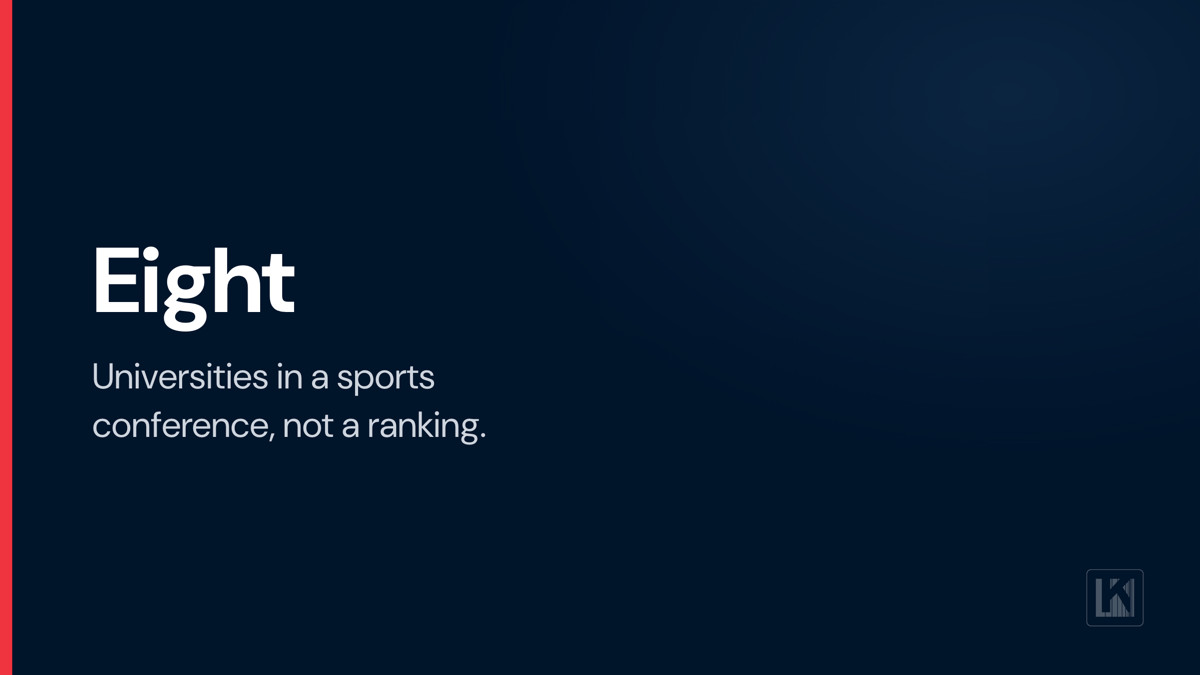
Ivy League The Ivy League is a group of eight private universities in the northeastern United States: Brown, Columbia, Cornell, Dartmouth, Harvard, Pennsylvania, Princeton and Yale. It began as an athletic conference, not an academic ranking, though the eight are now among the most selective institutions in the world.
Key facts
| What | Detail |
|---|---|
| The eight | Brown, Columbia, Cornell, Dartmouth, Harvard, Pennsylvania, Princeton, Yale |
| Origin | An athletic conference formed in the mid-twentieth century |
| Not a ranking | Several equally selective US universities are not members |
| Admission | Holistic: grades, rigour, essays, activities, recommendations |
| Acceptance rates | Typically in the low single digits for international applicants |
| Application route | Usually the Common App, plus institution-specific supplements |
| Cost | High published fees, with substantial need-based aid at several |
What the label does and does not mean
The Ivy League is a sports conference that acquired a reputation. Treating it as a ranking leads families to overlook Stanford, MIT, Chicago and others that are just as selective and often a better fit for a particular subject.
The useful filter is the course and the department, not the group. A student set on engineering has obvious destinations that are not in the league at all, and chasing the label rather than the programme is how strong applicants end up at the wrong place.
What an application at this level needs
Grades are necessary and nowhere near sufficient. At these acceptance rates most rejected applicants are academically capable; the file has to show something specific and sustained — depth in one area over years rather than a wide list of brief involvements.
Applications go through the Common App with supplementary essays for each institution, and several offer binding Early Decision rounds in early November.
Worth checking early: several of the eight offer need-based financial aid to international students, and a few assess need without it affecting the admission decision. The policies differ between institutions and are published on their own admissions pages.
At Schloss Krumbach
Nothing about this depends on a school being American. What it depends on is a recognised curriculum taken at its hardest available level, and a record of sustained commitment outside lessons — both of which the IB Diploma and Cambridge A Levels supply in a form US admissions offices read routinely.
The sustained part is where boarding helps: the weekend programme, peer tutoring, school musicals, the newspaper and study trips run over years rather than terms. Ask Admissions what guidance is available for US applications, since the essays and supplements need starting in the summer before Grade 12.
Frequently asked questions
Is the Ivy League a ranking of the best US universities?
No. It is an athletic conference of eight institutions. Several universities outside it are equally or more selective, and for some subjects clearly stronger.
Do Ivy League universities accept the IB Diploma?
Yes, and they read it closely. Higher Level subjects and strong grades are well understood, and several grant course credit for them.
Is financial aid available to international students?
At several of the eight, yes, on a need basis. Policies differ considerably between institutions, so check each one directly.
Free PDF guide
IGCSE, IB or A Levels: which route fits your child?
The routes from Grade 9 to university side by side: what each qualification involves, how universities read it, and the questions to ask any school.
The PDF opens right after you submit.